The Road of a Thousand Kasbahs in 8 days
Gorges, the Draa valley & Erg Chigaga- From
- €1,890
- Duration
- 8 days / 7 nights
- Group
- Private · 2 to 6 travelers
- Route
- Marrakech → Marrakech
01 / About this journey
Four hundred kilometres of valleys where every village built a fortress out of earth, then the dunes.
The “road of a thousand kasbahs” is the four hundred kilometres of valleys between Ouarzazate and Zagora, where every village built its fortified granary out of raw earth. This trip follows them in order, never drives the same road twice, and ends in the dunes.
The southern loop in eight days and a private 4×4: the Tizi n’Tichka, the earth-built kasbahs of the Dades and the Todgha, the Draa palm grove, a night in the Erg Chigaga and the way back through Aït Ben Haddou.
What’s included
- Airport transfers and a private air-conditioned 4×4 with driver for all 8 days
- 7 nights: riads, a hotel in Ouarzazate, a guest house, a kasbah hotel and Camp Chigaga
- 7 breakfasts and 7 dinners
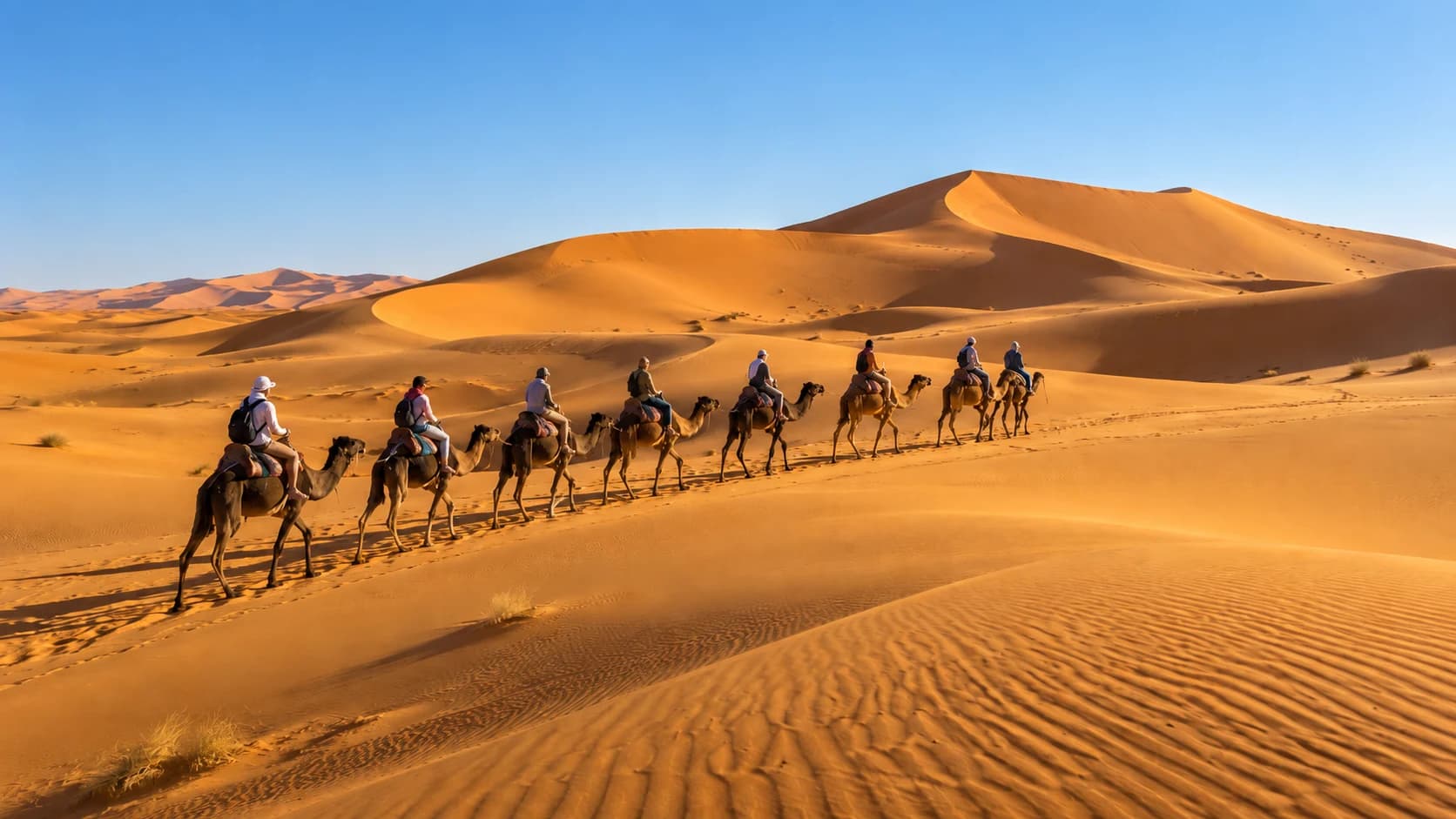
- A camel ride at first light in the Erg Chigaga
- An evening of music at camp
- Licensed guide for the half-day in the Marrakech medina
- Village guide for the visit to the ksar of Aït Ben Haddou
- Entry to the Telouet kasbah, the Amerhidil kasbah and the Tamegroute library
- Hammam and massage in Marrakech on day 7
- Bottled water throughout in the vehicle
The moments that stay
 01
01Stand under the painted cedar ceilings of the Telouet kasbah, half collapsed and nearly always empty.
 02
02Drive to the hairpins of the Dades gorge and walk the Todgha on the flat, on two consecutive days.
 03
03Sleep one night in the Erg Chigaga, two hours of track past the last tarmac at M’hamid.
 04
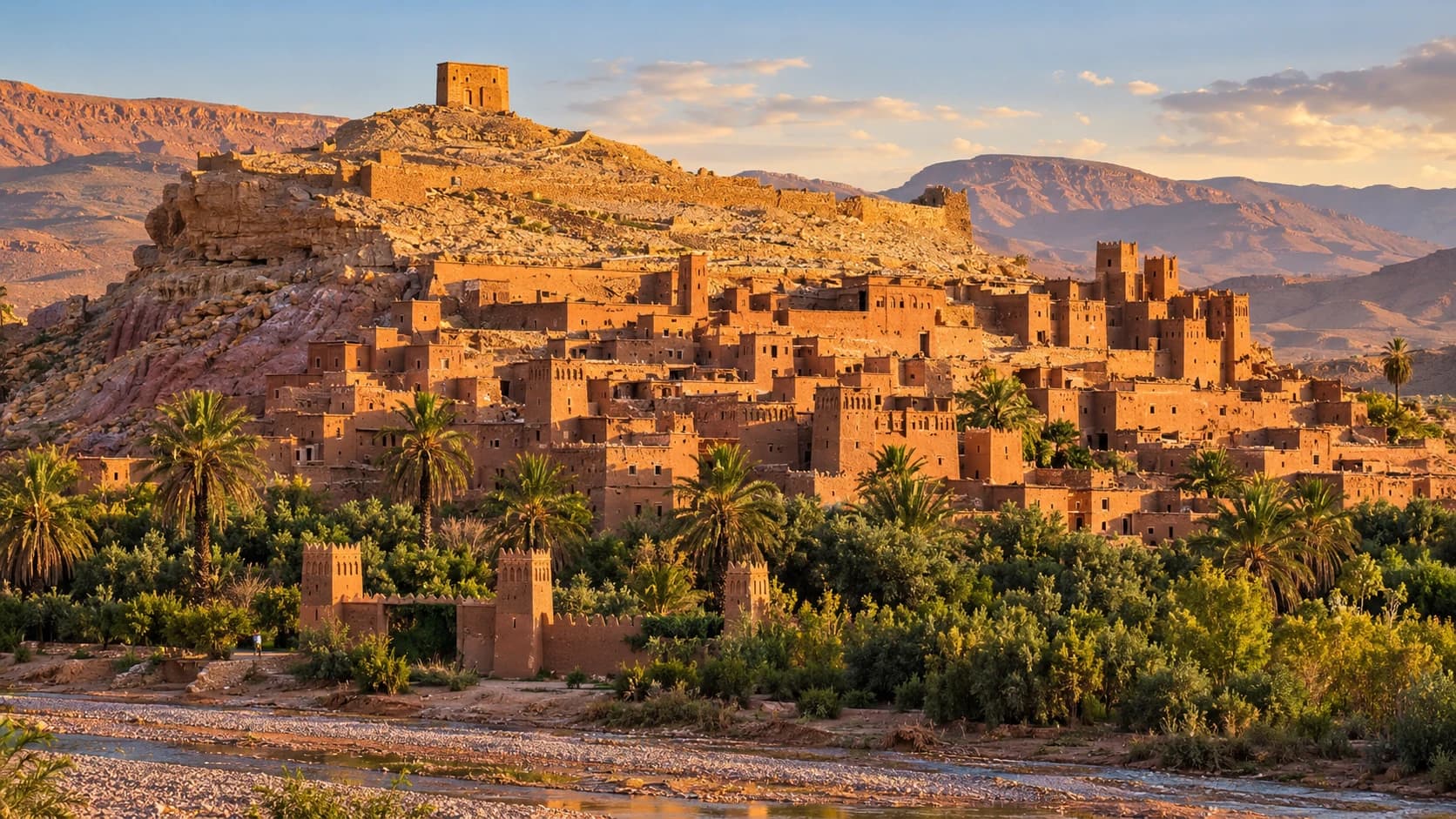
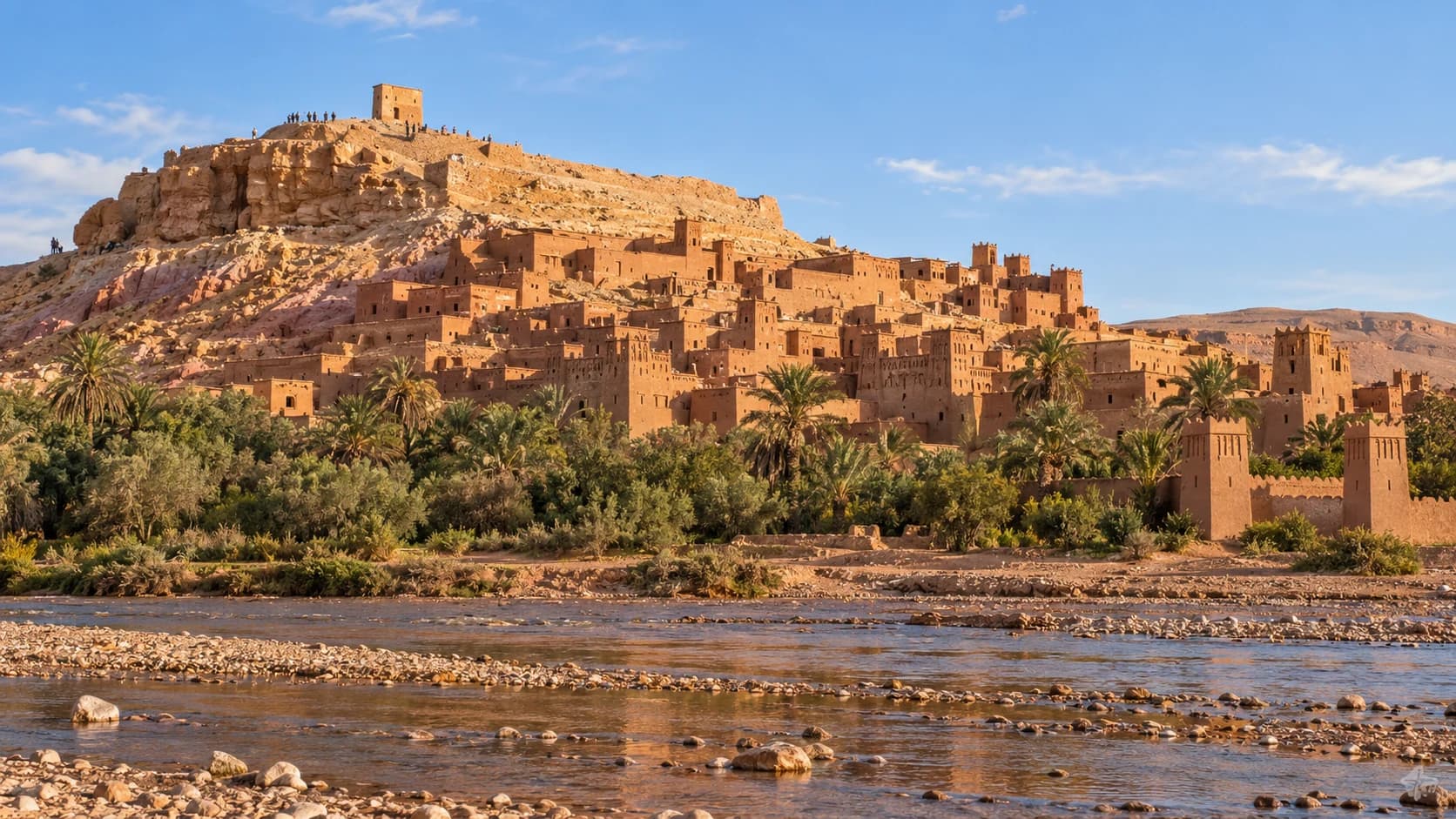
04Climb the ksar of Aït Ben Haddou at first light on the way home, before the first coach arrives at eleven.
02 / Your itinerary
Your itinerary
8 days / 7 nightsMarrakech → Marrakech · Easy · short walks, 3 to 5 h driving a day
We meet you outside the airport and take you to your riad in the medina. The driver who greets you is the one who stays with you for all eight days; that is deliberate, and it makes a difference by the fifth, when you no longer have to explain what you want. The rest of the day is yours. If you land before noon, the riad terrace and a two-hour nap are a better investment than the souks — you will see those on day 8, with a guide, and knowing where you are putting your feet. Dinner at the riad, and an early night: tomorrow starts with five hours of road and a pass at 2,260 metres.
Away around eight for the Tizi n’Tichka: 2,260 metres, two hours of hairpins, and a pass that changes countries on you. The northern side is green, the southern side red and bare, and the switch happens in three bends. Twenty kilometres past the summit a side road runs to Telouet. The Glaoui kasbah there has been falling down since 1956, except for three reception rooms with painted cedar ceilings and intact zellij: you step from a collapsed corridor into a room that looks as though it was left yesterday. It is half collapsed, nearly always empty, and it is the best hour of the day. We come down afterwards through the Ounila valley and reach Ouarzazate in the late afternoon, a hotel with a pool.
This is the day the trip is named after. The road runs east through Skoura, where the Amerhidil kasbah still opens to visitors in the middle of the palm grove — it is the one on the fifty-dirham note, so take one out and compare. Then Kelaat M’Gouna and the valley of roses, whose fields only smell of anything in May, and we will not claim otherwise in October. We drive up the Dades gorges as far as the Tissdrine hairpins, a stack of switchbacks you look down on from the café above, come back down, and cross over to the Todgha. The bottom of the gorge is busy in the middle of the day; we get there around five, once the coaches have gone and the rock has turned orange.
We go around the Jbel Saghro on the southern side, on a road almost nobody takes: Alnif, plateaux of black stone where the horizon does not move for an hour, then Nkob and its forty-five kasbahs lined up above the palm grove. The village claims the highest count in Morocco, and you believe it while counting them from a café terrace. Lunch there. In the afternoon the Draa valley opens at Agdz and never really closes: a hundred and fifty kilometres of near-continuous palms down to Zagora, with rammed-earth ksour every few kilometres and children waving from the edge of the irrigation channels. Five hours of driving, the longest day at the wheel before the desert.
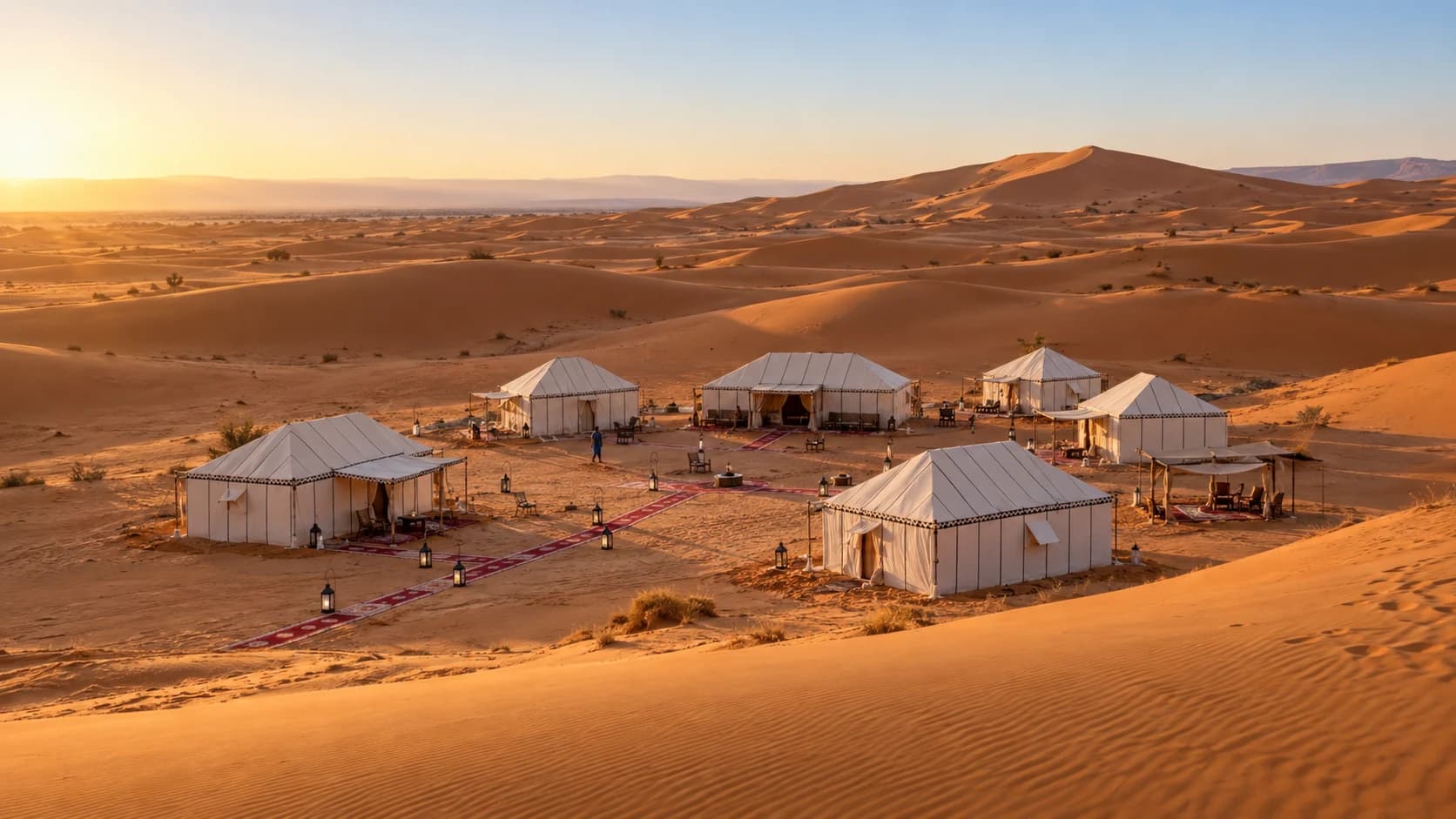
A short stage on tarmac and a long one on track. We stop at Tamegroute for the Koranic library — a few thousand manuscripts, some from the thirteenth century, in two tiny rooms — and for the potters, who get their particular green from a manganese oxide fired in palm-fed kilns. At M’hamid the tarmac ends for good: two hours of piste, stony reg and then sand, to Erg Chigaga. Forty kilometres of dunes rising to three hundred metres, with no road in and therefore none of the quad bikes of Merzouga. Sunset on the ridge, then dinner at Camp Chigaga: couscous, a tagine or a barbecue depending on what you chose, with salad and mint tea, and the musicians round the fire. The sky here is the real reason for the two hours of track.
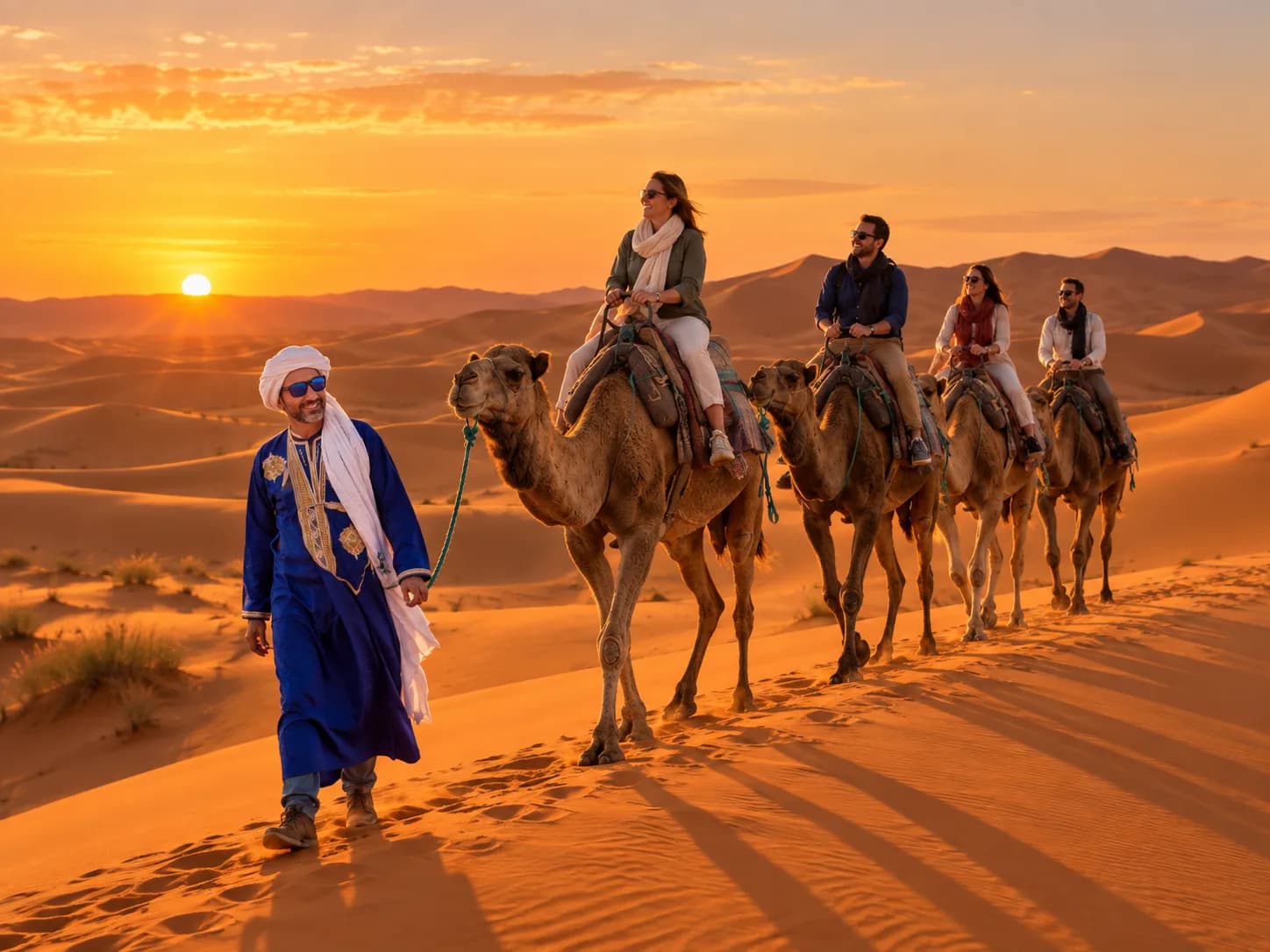
An hour on camelback at first light, before the sand heats up. An hour is enough, and nobody has ever wished we had planned three. Breakfast at camp, then the northern track towards Foum Zguid, across the dried bed of Lake Iriqui: forty flat minutes without a single marker — no tree, no relief, no tracks — and the part of the trip people bring up most afterwards. A stop at Taznakht with the Ouaouzguite weavers, where you can watch a rug being made without buying anything. Then Aït Ben Haddou at the end of the day, a hotel facing the ksar. It is the longest day of the trip, around seven hours between road and track, and we would rather say so before you book than over breakfast.
The ksar is worth seeing at eight in the morning or not at all: it is the only slot in which you climb to the fortified granary without meeting a group, and the low light on red earth does the rest. A village guide opens two houses that are still lived in — five families remain inside the walls, against about a hundred sixty years ago, and he will explain why the others moved across the river. Back to Marrakech over the Tichka in the afternoon, with a lunch stop in the mountains and, one last time, that switch of colour — the other way round. Hammam and massage on arrival, then dinner in the medina.
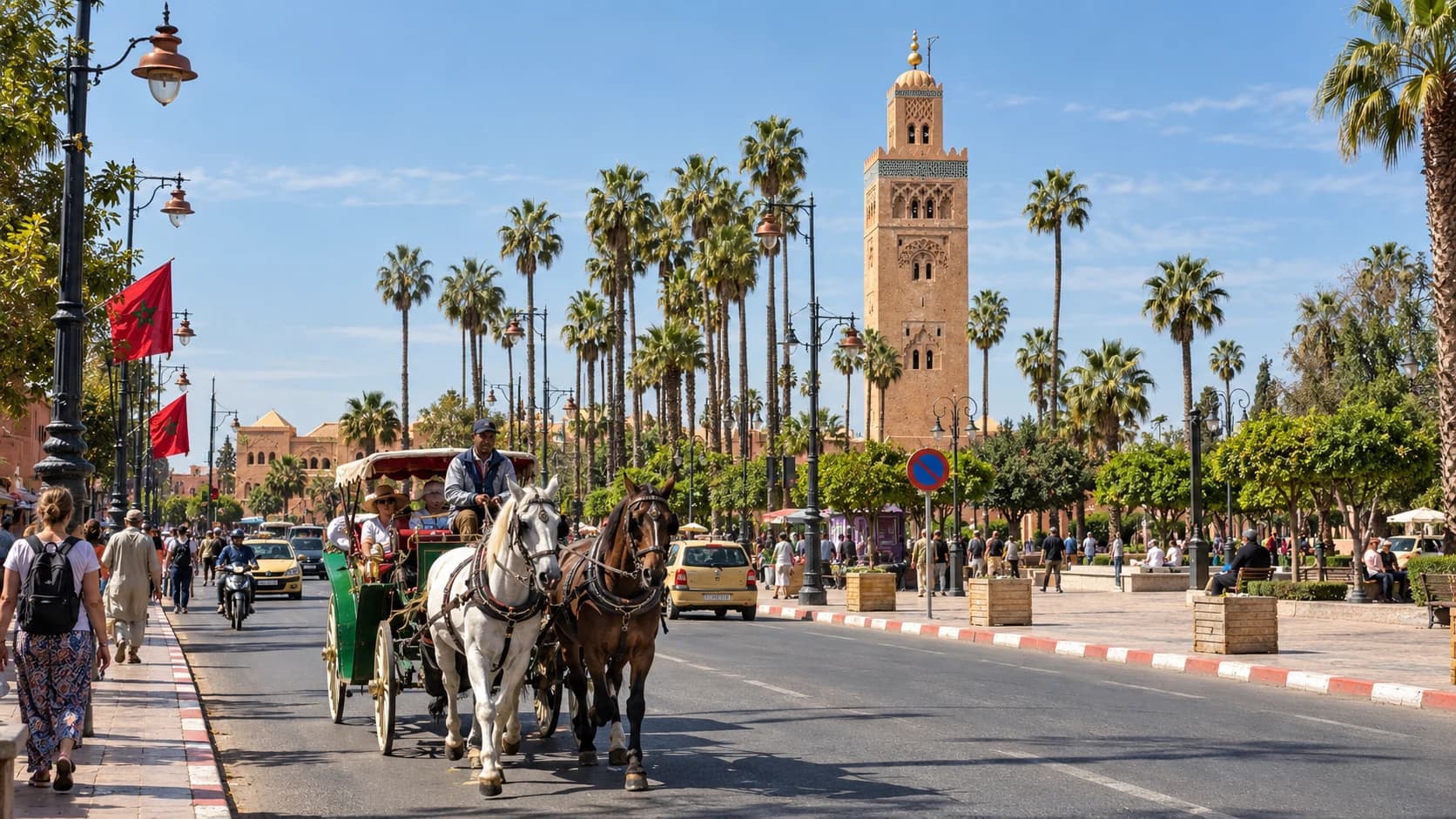
A half-day with a licensed city guide: the Koutoubia, the Ben Youssef medersa and its zellige courtyards, the dyers’ souk and the ironworkers’ souk, then Jemaa el-Fna. After a week of kasbahs the medina reads differently — the same rammed-earth walls, ten times richer, and you will recognise the patterns you saw at Telouet on the second day. A private airport transfer timed to your flight, not to check-out: the riad keeps your bags in between, and you can come back to freshen up before you go.
03 / Where you’ll stay
Six nights with walls, one night in the dunes
Six nights out of seven are houses: a riad in the Marrakech medina, a hotel with a pool in Ouarzazate, a riad facing the palm grove in Tinghir, a guest house in Zagora, a kasbah hotel opposite the ksar at Aït Ben Haddou. All have hot water, wifi and air conditioning — except Tinghir, where metre-thick earth walls do that job. The seventh night is under canvas in the Erg Chigaga: a bed with sheets, wool blankets, a private bathroom and a hot shower inside the tent. It is not camping, but it is not a hotel either, and the generator goes off around midnight.
04 / The route, at a glance
The route, at a glance
Stops are indicative and can be adapted to your pace.
Marrakech → Marrakech
05 / Before you go
Before you go
- Every day is a driving day, but none over six hours, and the road is the point: you see the valleys from the car, then walk into them.
- One night in the Erg Chigaga, two hours of track from M’hamid, in a tent. From December to February the nights are cold in the dunes; the rest of the year the problem is the opposite one.
- September to May is the season. In July and August the valleys are hot but bearable; the erg is not.
- Aït Ben Haddou and Telouet mean steps and uneven ground. Nothing long, but closed shoes rather than sandals.
- Morocco tips. Your driver, the village guide and the camp team expect it; we tell you what is usual before you leave.
What’s not included
- International flights
- Lunches (budget 80 to 150 dirhams per person) and all drinks
- Travel and repatriation insurance
- Tips for the driver and the guides
- Personal spending, Taznakht rugs and Tamegroute pottery
To prepare for this journey
Erg Chebbi or Erg Chigaga: which desert should you choose?What should you pack for the Moroccan desert?Six, eight or ten days in Morocco: which pace should you choose?Your questions
How much driving is there really each day?
Three to five hours on days 2, 3, 4, 5 and 7, stops included. Day 6, between Erg Chigaga and Aït Ben Haddou, comes to around seven hours, ninety kilometres of it on track. That is the cost of closing the southern loop without doubling back, and it is the day to be aware of before booking. If it worries you, we break it with a night at Foum Zguid and the trip becomes nine days.
Why Erg Chigaga rather than Merzouga?
Because it closes the loop: you go into the erg from Zagora and come out at Foum Zguid, never repeating a road. Merzouga would force an out-and-back through the Ziz valley, and a tarmac road runs to the foot of the dunes there, bringing the quad bikes, the groups and some thirty camps with it. Erg Chigaga is longer, emptier, and has to be earned with two hours of track. If you would rather have Merzouga, say so and we rewrite days 4 and 5.
When is the best time for the kasbah road?
October–November and March–April are the two best windows: 22–28 °C in the valleys, cool nights in the desert, and the gorges without the summer crowds. In May the valley of roses is in flower for about two weeks and it is worth planning around. From December to February the days are fine but nights get close to freezing at Erg Chigaga: bring a proper jumper. In July and August Zagora regularly passes 45 °C — we then start very early in the morning, or advise you to travel in another season.
Does this trip work with children?
Yes, from about six or seven, and it is one of the trips we sell most to families. The 4×4 is private, so we stop when a child needs to, and the gorges, the camels and the night at camp all land well at that age. Day 6 is the only real difficulty: for families we often split it in two with an extra night. Booster seats provided on request — mention it in your enquiry.
What is the camp in Erg Chigaga like?
It is a permanent camp, not a bivouac put up for the night: a wool canvas tent, a double bed with sheets, blankets, rugs on the floor, and a private bathroom behind a partition with a hot shower and a toilet. Power comes from a generator that shuts off around midnight — bring a head torch and charge your phone before then. There is no wifi and the signal comes and goes. One night out of seven, and the one people remember.
Does the price drop if there are more of us?
Yes. The €1,890 rate is per person for two to four travelers. At five or six it comes down to €1,590 per person: the 4×4 and the guides are the same, they are simply shared. Above six we move to two vehicles and re-quote, which usually works out slightly cheaper again per person. Tell us how many you are in your enquiry.
What do we eat at the camp?
You choose: couscous, a tagine, or a barbecue. It comes with Moroccan salad and mint tea. The camp kitchen is small and cooks to order, so tell us at booking if anyone is vegetarian or avoids something — it takes one sentence to sort out.
Is it the same driver for the whole trip?
Yes. The person who meets you on the first day stays with you until the final drop-off — the same driver-guide, the same vehicle. It sounds like a detail until the third day, when you no longer have to explain that you would rather stop for a coffee than for a photograph.
What does this trip support locally?
We give ten per cent of what we earn to small cooperatives in the regions we drive through, to help them grow their own business. It is not a line added to your invoice — it comes out of our side of it.
Your journey starts here
Let’s plan your journey.
Your dates, your wishes, your pace. Tell us what matters to you and our local team will reply with a personal proposal.
Or write to uscontact@kasbahroutes.com