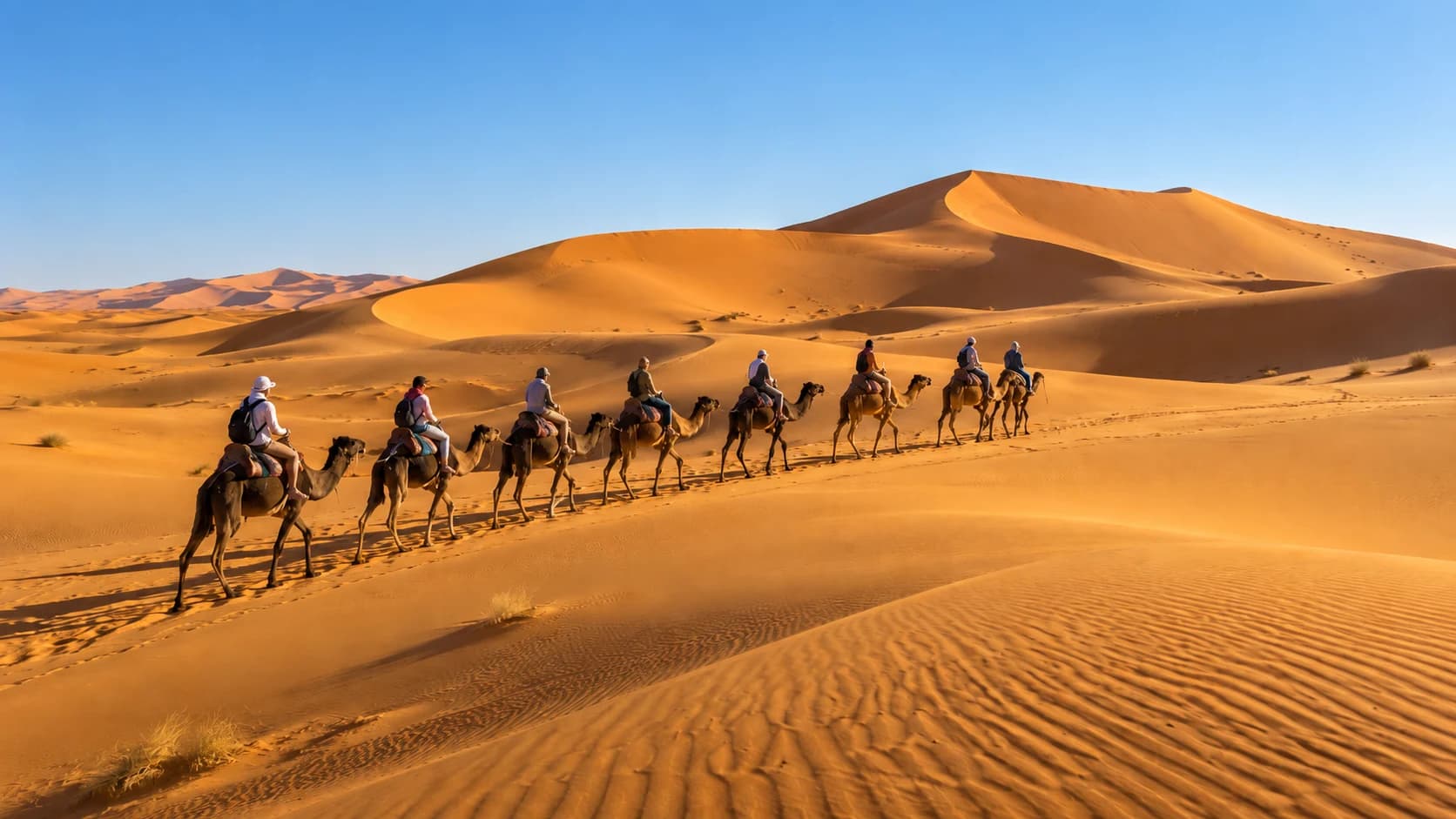
The short answer
Choose Erg Chebbi if you want dramatic dunes with more direct access through Merzouga and a wider range of services. Choose Erg Chigaga if the journey through the Draa Valley and along desert tracks, a greater feeling of remoteness and a more expedition-like experience matter more than simple logistics.
The differences that genuinely change the journey.
| Your question | Erg Chebbi | Erg Chigaga |
|---|---|---|
| Final approach | Road to the Merzouga area, then a transfer to camp | Desert track from M’hamid or Foum Zguid, normally by 4×4 |
| Atmosphere | More camps, activities and accommodation choices | More remote, with the approach forming part of the experience |
| Best suited to | A first desert visit or a shorter itinerary | Southern circuits, trekking or travellers seeking distance |
| Flexibility | Easier to adjust accommodation and activities | More dependent on tracks, vehicle and conditions |
An erg is a sea of dunes, not the whole desert.
Begin by defining the experience hidden behind the word desert. Do you want to see high dunes at sunset, walk for several hours, spend two nights away from a settlement or simply add one memorable night to a southern circuit? Erg Chebbi and Erg Chigaga can both include sand, a camp and a camel outing, but the time required to approach them changes the rest of the journey. The better choice protects the balance of the whole itinerary instead of pursuing one image in isolation.
Ask where the camp is located in practical terms. The name of the erg does not tell you the distance between tents, whether other camps are nearby or how the final access works. A place described as remote may sit beside a busy track, while a comfortable camp can feel calm when its position and timing are well considered. Compare the actual sequence—vehicle, walking, sunset, dinner, sunrise and departure. That sequence shapes the feeling of the night more reliably than a general label such as wild or luxury.
Also compare what must be removed to reach each erg. A more remote camp may require an earlier departure, fewer village stops or a longer final transfer. A simpler approach can preserve time for a kasbah, market or slower morning elsewhere. Neither trade-off is universally better. Decide whether the dunes are the journey’s main purpose or one strong chapter within a broader route through southern Morocco.
Erg Chebbi and Erg Chigaga are two dune systems in the Moroccan Sahara. Southern Morocco around them also includes stony hamada, palm groves, valleys and villages. Choosing an erg is therefore not simply a comparison of dune height or sand colour: you are choosing an approach, a pace and the type of journey surrounding the night at camp.
Erg Chebbi stands beside Merzouga in eastern Morocco. Erg Chigaga lies farther west beyond M’hamid, at the end of the Draa Valley. Both can offer sunset, time on the dunes and a night beneath a clear sky. The difference travellers feel most strongly often comes from what happens before and after the camp.
Chebbi simplifies arrival; Chigaga extends the approach.
At Merzouga, paved roads lead to the edge of the dunes. Depending on the camp, the final section is by 4×4 or camel. This proximity makes short stays, programme changes and a choice of comfort levels easier. It also means tourism activity is more visible around some parts of the erg.
Reaching Erg Chigaga means leaving the road and following a desert track. Time off tarmac is part of the journey, crossing open ground before the dunes appear. In return, the approach depends more on the vehicle, driver and conditions. Travellers who dislike prolonged bumps should discuss this before confirming.
Remoteness is not measured only by the number of tents.
A camp at Erg Chebbi can be quiet and carefully placed, while a Chigaga camp may host several groups. Labels such as “authentic” or “wild” are not enough. Ask how many tents the camp has, whether it is permanent, where the nearest other camps are and whether motorised activities can be heard nearby.
At Chigaga, the longer approach usually produces a stronger sense of separation from towns. At Chebbi, the dune line appears more directly and can feel spectacular from the moment of arrival. Your preference depends on what moves you: a gradual journey into isolation or the immediate impact of a large wall of dunes.
For a multi-day walk, look beyond the name of the erg.
A genuine trek follows a moving route, with stages selected for the terrain and bivouac points. It is not simply a daily loop from one fixed camp. Erg Chigaga fits naturally into routes beginning near M’hamid and the Draa Valley, but the quality of the experience depends more on the team, actual walking time and capacity to adapt each stage.
Around Erg Chebbi, shorter walks from Merzouga suit a first experience or a road-based journey. They can be beautiful without becoming a trek. Be clear about whether you want a sunset walk, a full day on foot or several mobile nights: these experiences need different amounts of time, preparation and equipment.
Choose the journey around the dunes first.
From Marrakech, Chebbi combines naturally with Aït Ben Haddou, Todgha and the Dades Valley. Chigaga follows the axis of the Draa Valley, M’hamid, Foum Zguid and sometimes the Anti-Atlas or Agadir. If one of those places matters to you, let it lead the decision. Otherwise compare complete days, not only the advertised desert night.
For a short first visit, Chebbi’s clearer access often feels reassuring. For a longer southern circuit, trek or arrival from Agadir, Chigaga may create a more coherent route. There is no universally “better” desert: the better choice avoids an artificial detour and respects your tolerance for road and track travel.