Sahara Walking Holiday — Erg Chigaga in 8 days
Three days walking with the nomads- From
- €1,950
- Duration
- 8 days / 7 nights
- Group
- Private · 2 to 6 walkers
- Route
- Marrakech → Marrakech
01 / About this journey
Three days on foot with a nomad team, and a 4×4 carrying everything you would rather not.
A Sahara trek that is not an expedition: you walk three to six hours a day, the 4×4 carries the bags, and the desert starts where the tarmac ends, at M’hamid.
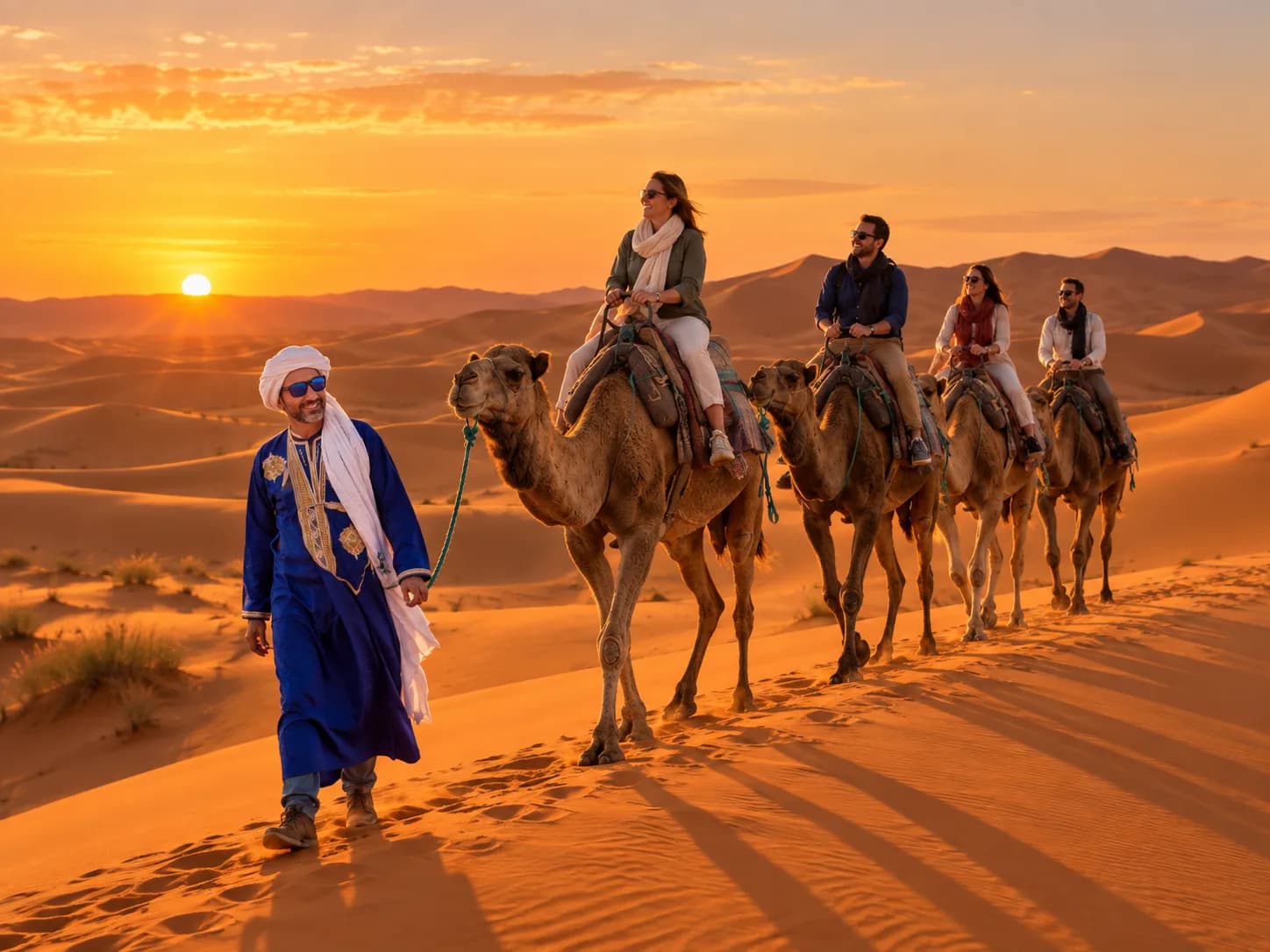
Eight days between Marrakech and Erg Chigaga, three of them on foot along the Draa and across the Zahar plain, with a nomad team, a 4×4 in support and camps pitched for you.
What’s included
- Airport transfers and a private air-conditioned 4×4 with driver for all 8 days
- 7 nights: riad, kasbah hotel, nomad camps and Camp Chigaga
- 7 breakfasts, 3 lunches and 7 dinners
- Berber trekking guide and nomad team for the three walking days
- 4×4 support on every walking day (luggage, water, lunch)
- Licensed guide for the half-day in the Marrakech medina
- Visit to the ksar of Aït Ben Haddou with a village guide
- An evening of music at camp
- Hammam and massage in Marrakech on day 7
- Bottled water throughout the trip
The moments that stay
 01
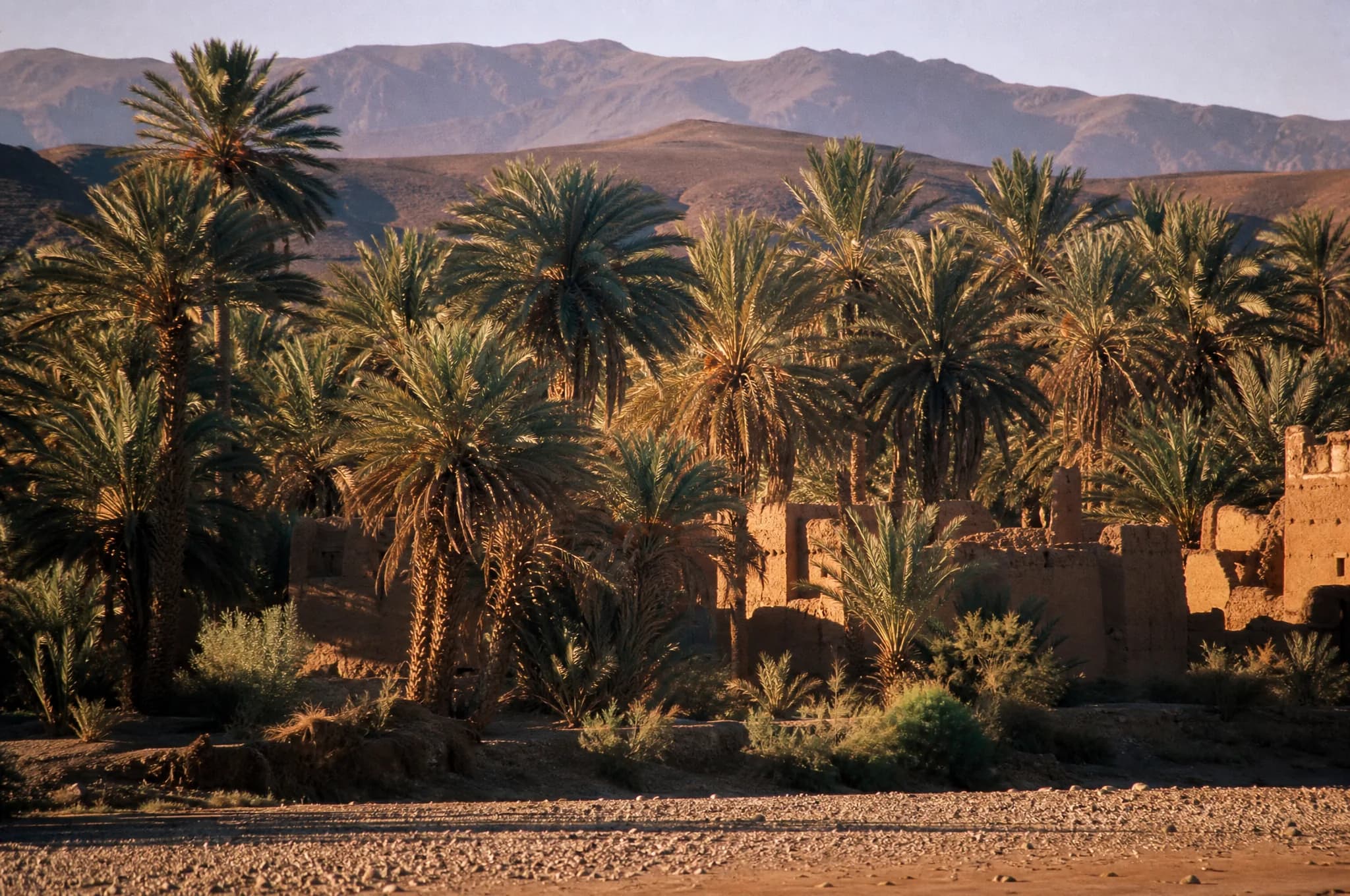
01Follow the Draa for a hundred and fifty kilometres of palm grove before the tarmac ends at M’hamid.
 02
02Walk three to six hours a day for three days with a nomad team, while the 4×4 carries the bags and pitches camp ahead of you.
 03
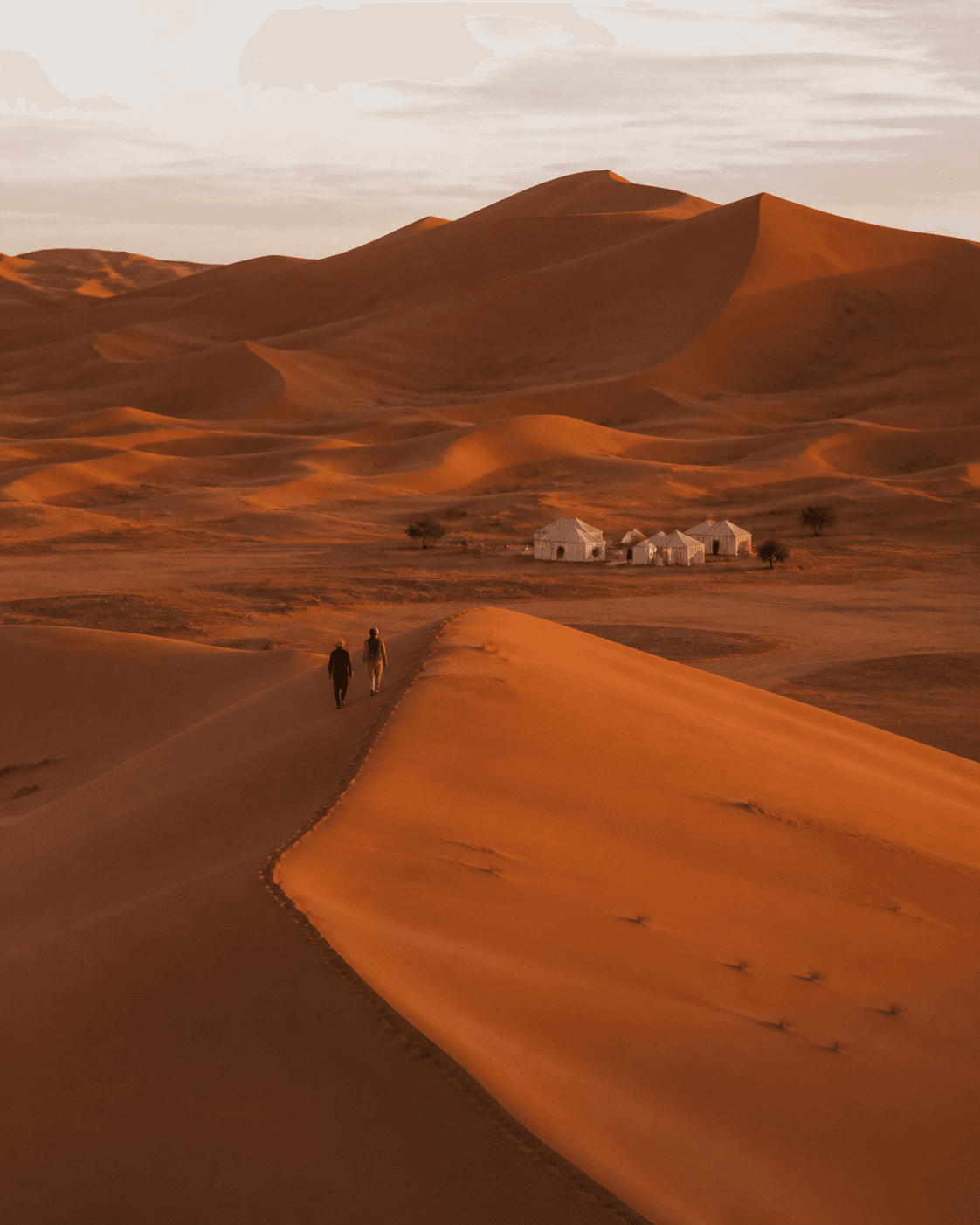
03Sleep on the far side of the Erg Chigaga dunes, two hours of track from the nearest road.
 04
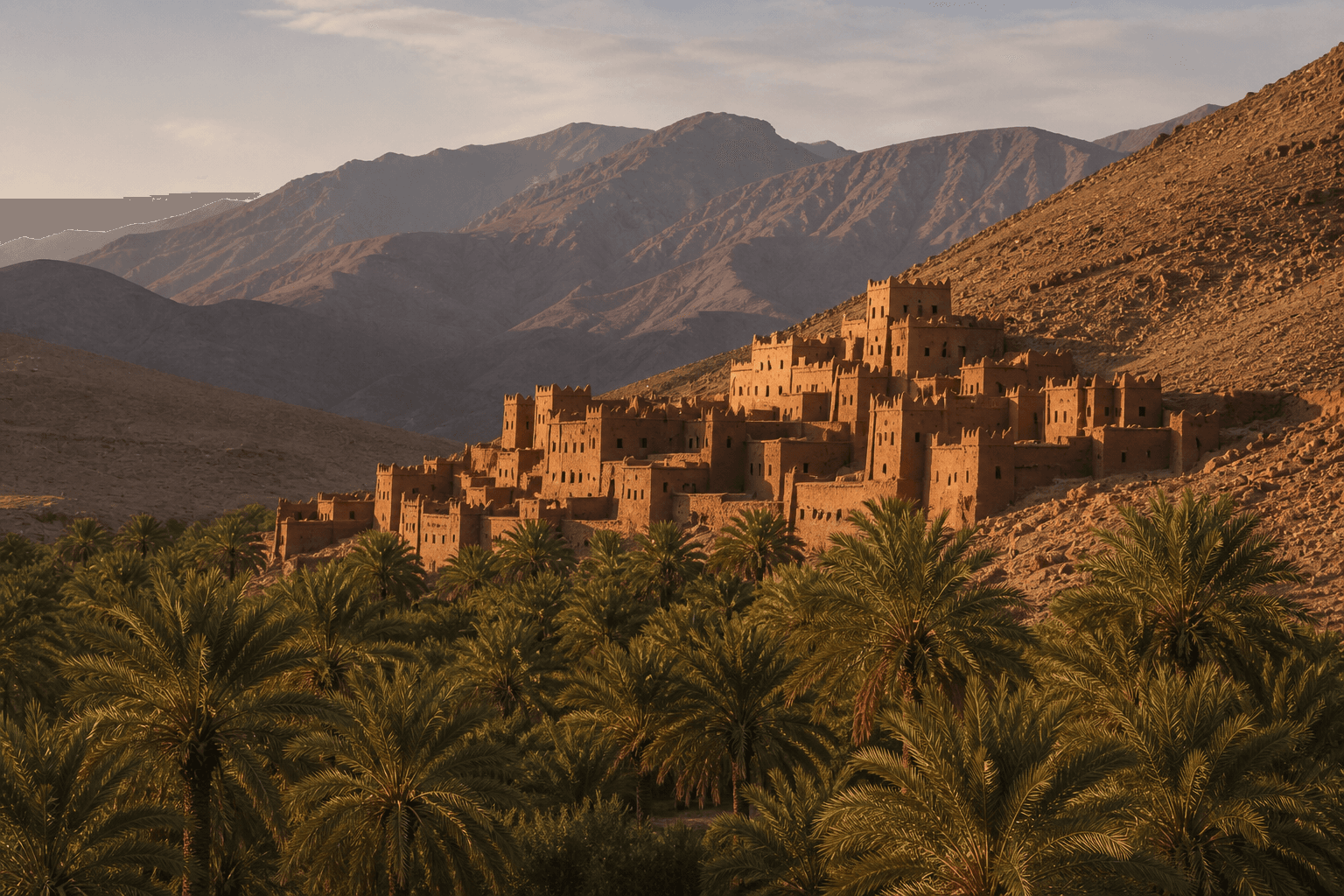
04Cross the Tizi n’Tichka and climb the ksar of Aït Ben Haddou on the way out, while your legs are still fresh.
02 / Your itinerary
Your itinerary
8 days / 7 nightsMarrakech → Marrakech · Moderate · 3 to 6 h walking a day, over three days
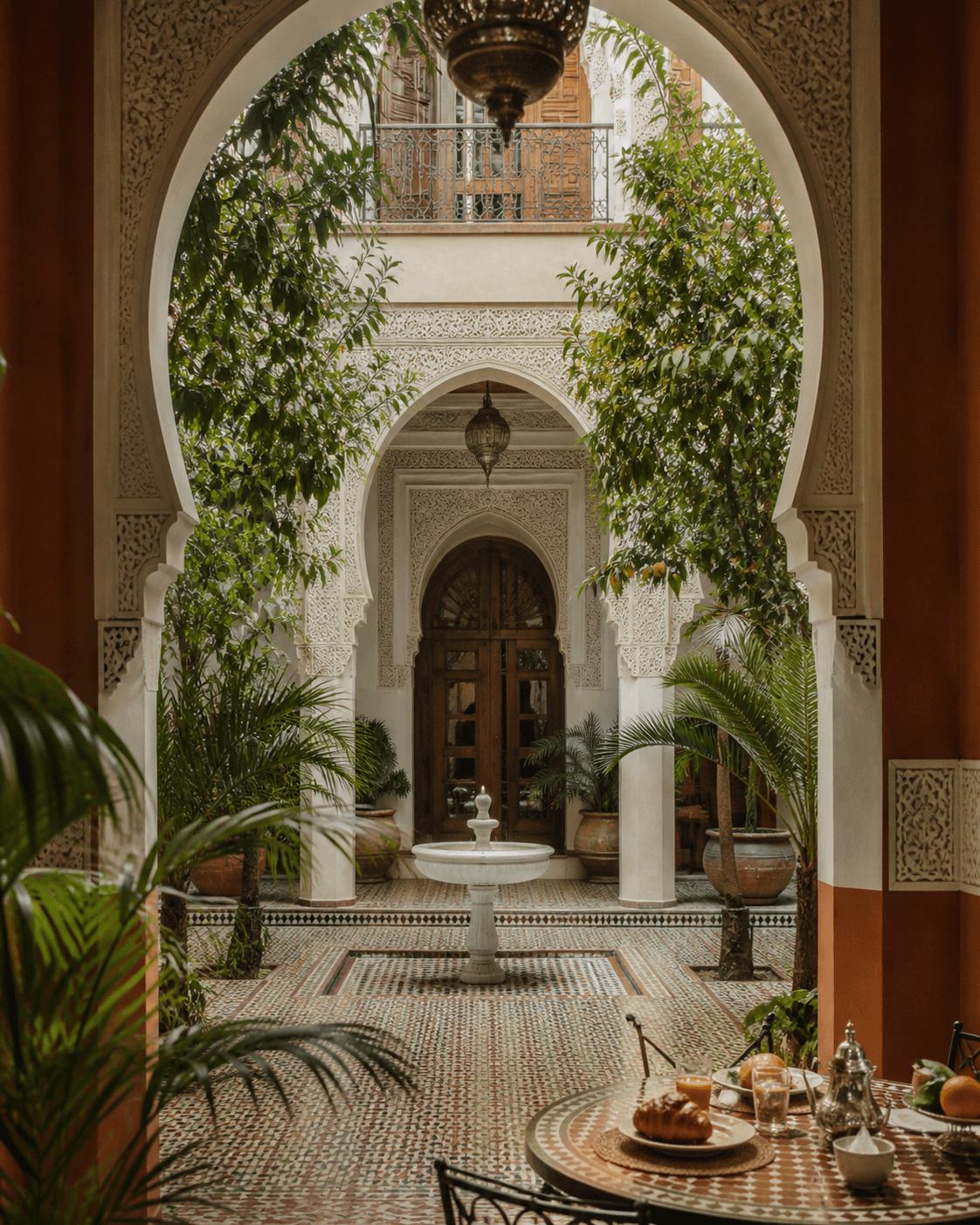
We collect you at the airport and take you to your riad inside the medina; the driver who meets you stays with you for all eight days. In the afternoon a city guide walks you round for three hours: the Koutoubia, the Ben Youssef medersa and its zellige courtyards, the dyers’ and ironworkers’ souks, then Jemaa el-Fna at the hour the food stalls go up and the square changes character completely. It is not the most exotic day of the trip, but it does two things: it gets your legs moving, and it puts you to bed on local time — which you will be grateful for on day 4. Dinner at the riad, and a night in a proper bed.
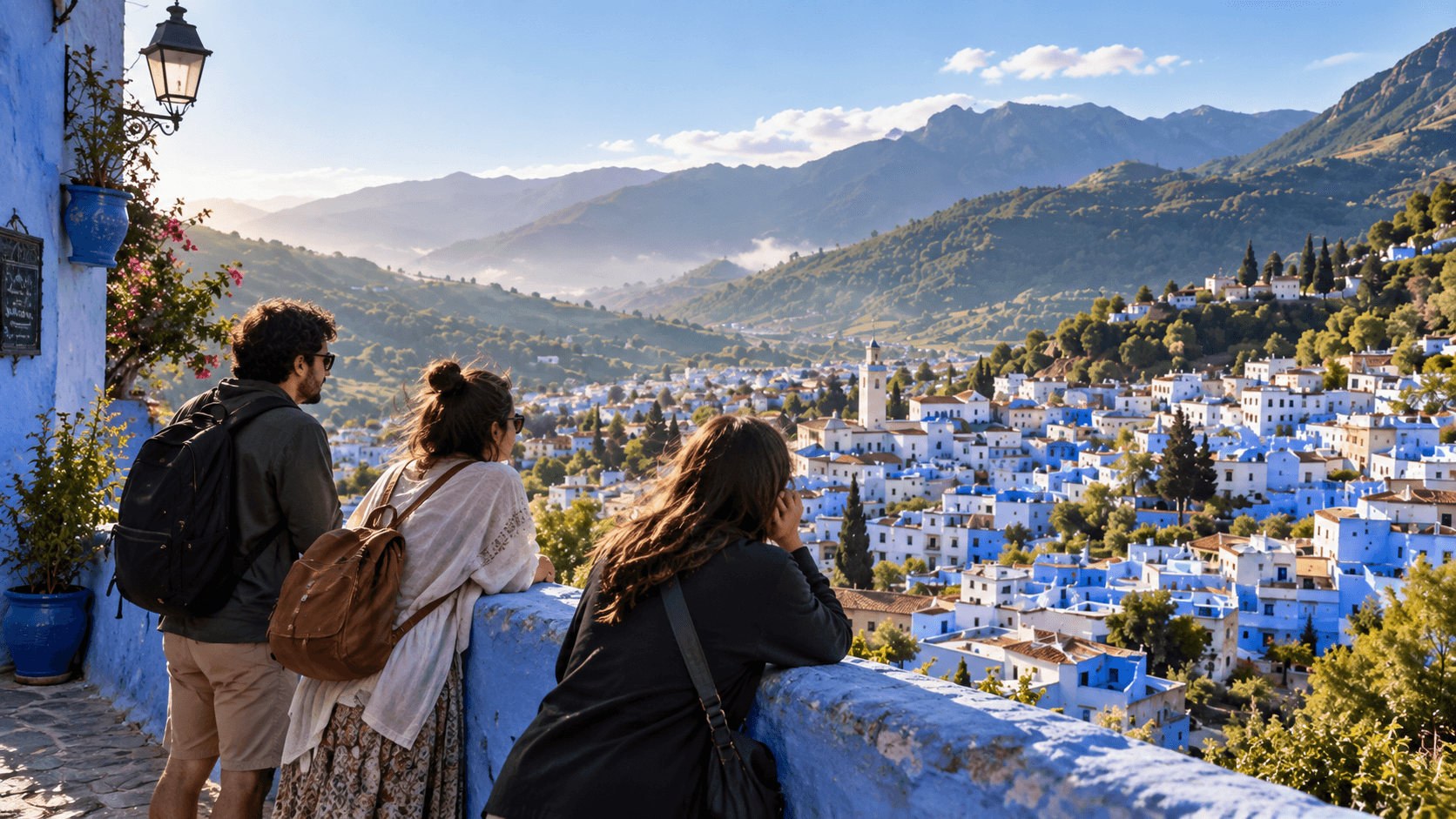
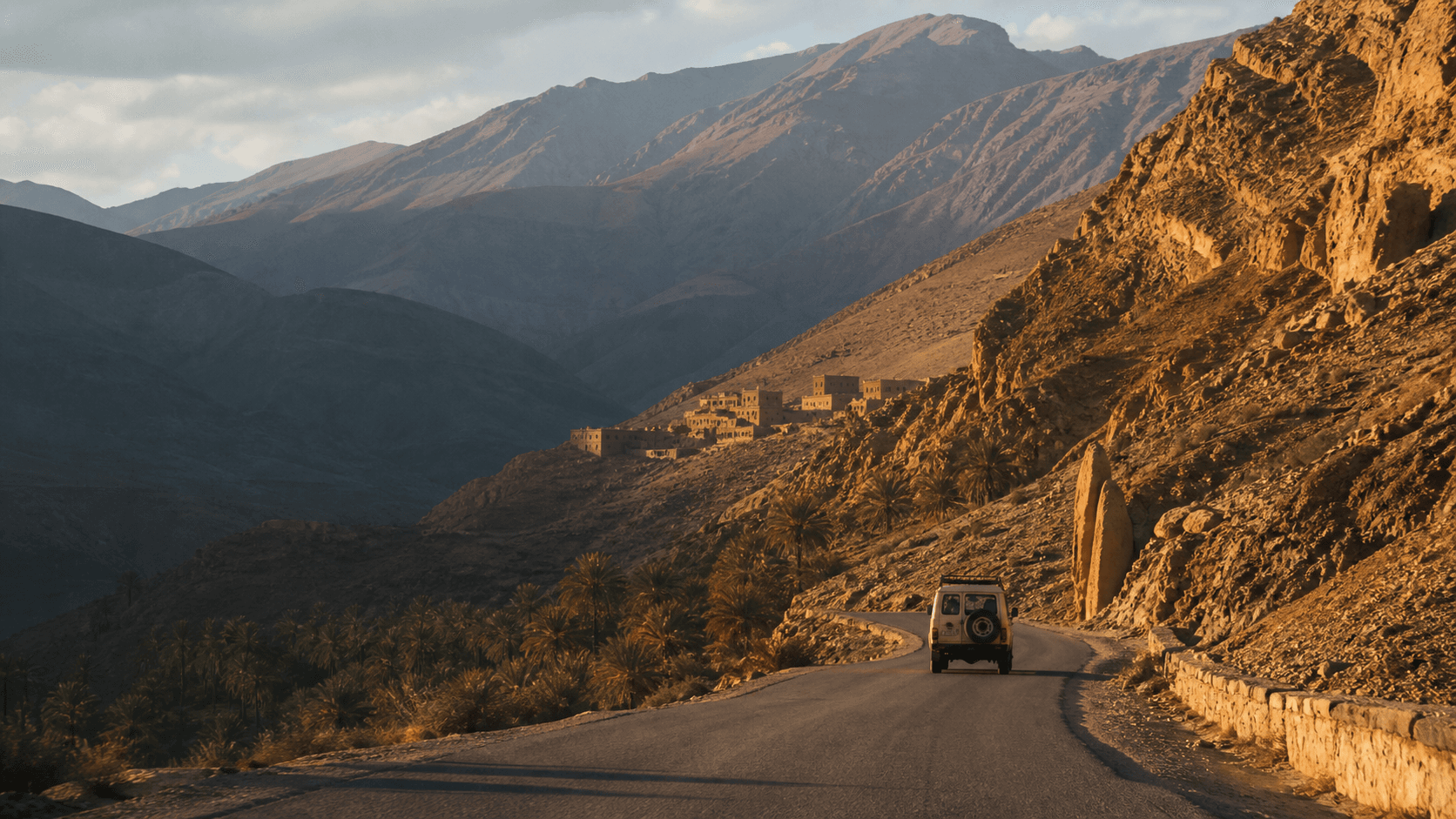
Away around eight. Two hours of hairpins to the Tizi n’Tichka pass at 2,260 metres: labouring trucks, villages hanging off the slope, fossil stalls at every flat spot. Then over onto the southern side, where the greenery stops dead and the earth turns red. Lunch in a mountain village. You reach Aït Ben Haddou in the early afternoon, which leaves time to cross the river on foot and climb to the fortified granary with a village guide, before the light turns and once the coaches have gone. The hotel has a pool; after four hours in the car, it earns its keep. It is also your last proper bed before three nights under canvas — better to know that now than on Thursday.
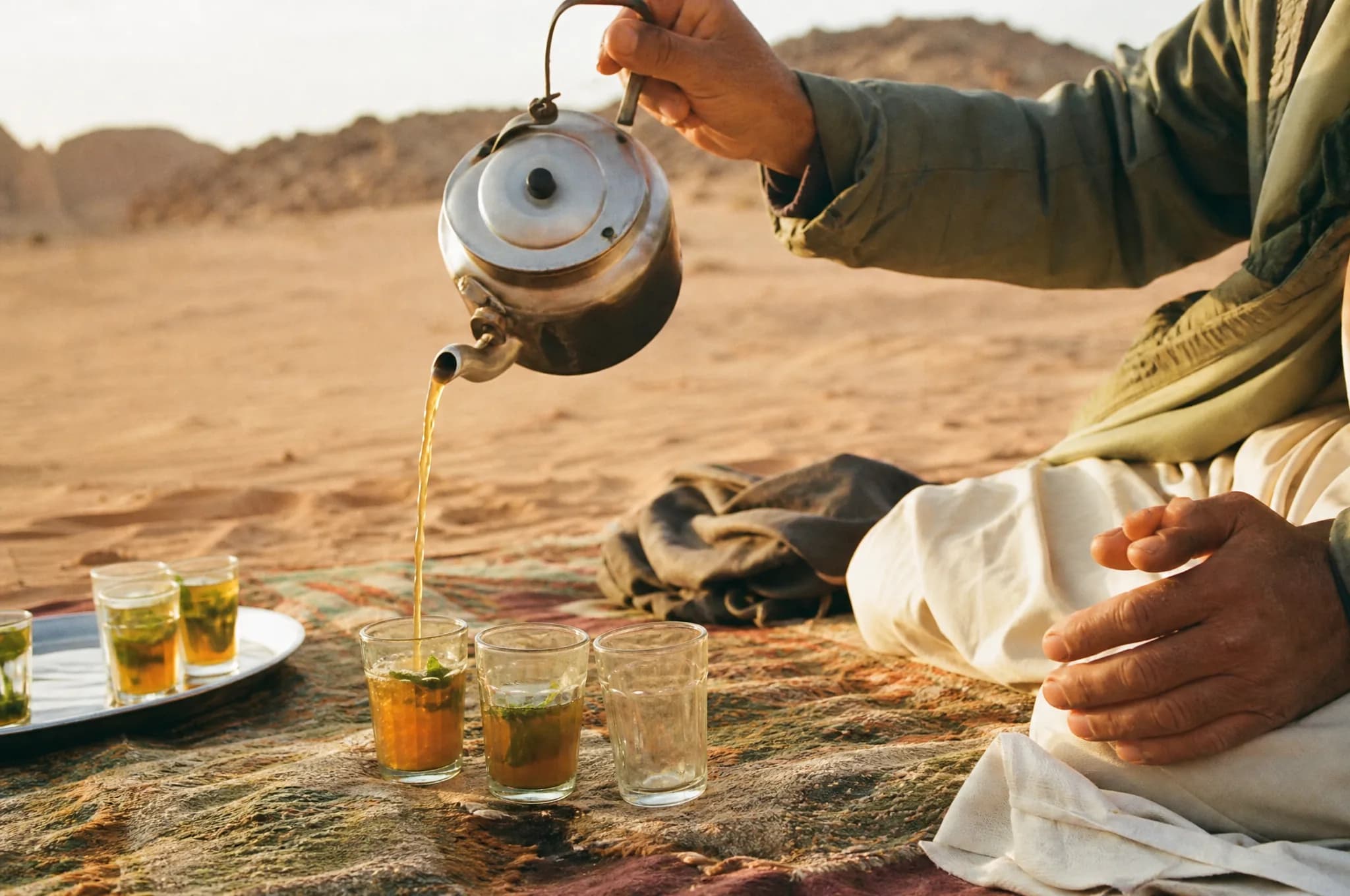
The Draa valley is a hundred and fifty kilometres of near-continuous palm grove between Agdz and Zagora — the longest in Morocco, and the one nobody stops in long enough. We take the time to walk down into it once, between the irrigation channels, where the shade is dense and you finally understand how an oasis actually works. At M’hamid the tarmac ends for good. An hour of track brings you to the trekking camp, pitched by the nomad team who will walk with you for the next three days: you meet them tonight, around the fire, which is better than meeting them on a track at seven in the morning. Dinner under canvas — couscous, a tagine or a barbecue depending on what you chose, with salad and mint tea. A briefing on tomorrow’s pace, then the first night with no light on the horizon.
The first walking day, and the gentlest of the three. You follow the bank of the Draa between palms, barley fields and stony flats as far as Sidi Naji: three to six hours depending on your pace — it is flat, and the sand does not start until tomorrow. The trekking guide leads, the nomad team follows, and the 4×4 goes round by the track with the bags, the water and lunch, which is laid out in the shade around midday — you carry nothing but a day pack. The afternoon is hotter and slower. If the heat or the blisters win late in the day, you get in the 4×4: it happens on roughly one trip in three and nobody makes anything of it. The evening camp is already pitched when you arrive, which on the first day you notice.
The bleakest day and, for a lot of people, the best: an open plain to the horizon, a few black tents belonging to nomad families grazing goats, and the Zahar dunes swelling in front of you for hours without ever seeming to get closer. It is a walk on which people talk very little, and it is not tiredness. Camp goes up at the foot of the dunes, and the sunset from the first ridge costs you ten minutes of climbing in soft sand. No shower that night — a basin of hot water, and that is it. It is the one real discomfort of the trip, it lasts a single night, and we deliberately put it in the middle of the trek rather than at the end.
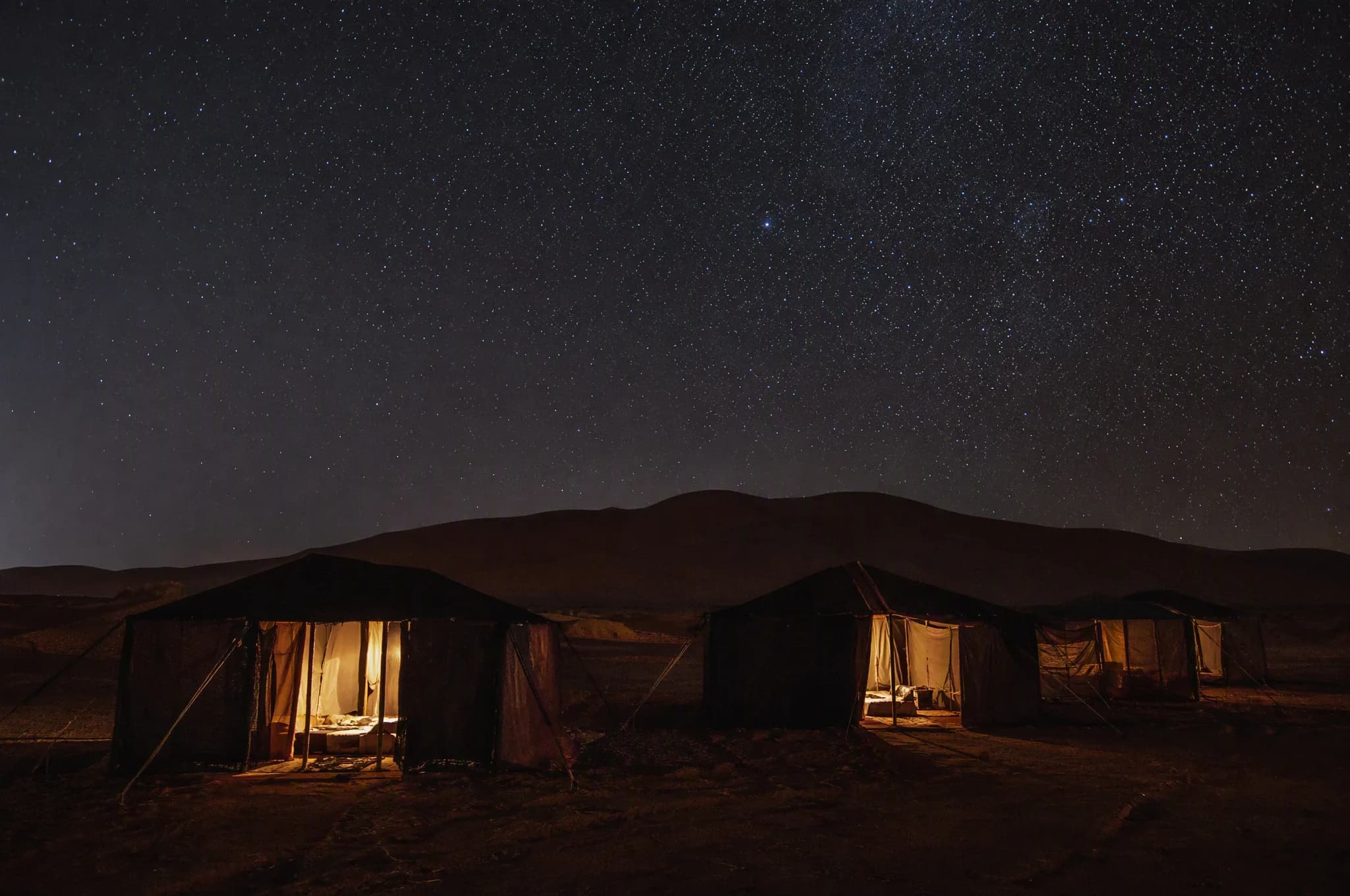
Three to six hours to Erg Chigaga: forty kilometres of dunes rising to three hundred metres, the largest reachable erg in Morocco, and without the quad bikes of Merzouga. The last hour is in soft sand and is harder than the previous two days put together — this is the point at which you are glad your bag is in the 4×4, and the point at which the team slows down without being asked. Camp Chigaga waits on the far side: real showers, beds, sheets, a bathroom inside the tent. The first shower after three days of walking ranks among the good memories of the trip, and we mean that seriously. Dinner by the fire — couscous, a tagine or a barbecue depending on what you chose, with salad and mint tea — and the camp musicians if the mood is there.
Back over the Iriqui track — a dried-out lake bed you cross flat and featureless for forty minutes: no tree, no relief, no marks, just the pale crust and the horizon. Then Foum Zguid, where the tarmac starts again, and Taznakht, where we stop at the weavers’ co-operative — the Ouaouzguite rugs are worth the stop even with no intention of buying, and nobody will push you. Eight hours of road, which is long, and we say so before you book rather than as you get into the car. Hammam and massage on arrival in Marrakech, which after three days of walking and a day of piste is not a decorative extra. Dinner in the medina. You will sleep well.
Breakfast at the riad and a free morning in the medina if your flight is late — the riad keeps your luggage, and by now you know the quarter well enough to go back on your own. Then a private airport transfer: we set the time by your ticket, not by the hotel’s check-out. If you want to add two nights in Essaouira or the Atlas, that is the request we get most often at the end of a trek, and it is far easier to arrange before you leave than once you are here.
03 / Where you’ll stay
Two comfortable nights, three nomad ones
Marrakech and Aït Ben Haddou are the easy nights: a riad in the medina, a kasbah hotel with a pool. The three trekking nights are another matter. At the M’hamid and Sidi Naji camps you get a canvas tent, a thick mattress, wool blankets and a dry toilet; at Zahar, a basin of hot water and nothing else. Camp Chigaga is permanent: a double bed, sheets, a private bathroom and a hot shower. We deliberately put the roughest night in the middle of the trek, not at the end.
04 / The route, at a glance
The route, at a glance
Stops are indicative and can be adapted to your pace.
Marrakech → Marrakech
05 / Before you go
Before you go
- You walk three to six hours a day for three days on sand, stone and flat riverbed, carrying only a day pack. Anyone who walks regularly can do it; anyone who does not should train a little first.
- The camps on the walking days are pitched for you but they are simple: on the Zahar night there is no shower, a basin of hot water and that is it. The permanent camp at Erg Chigaga has real showers, beds and sheets. We would rather say so now than on day 5.
- From mid-June to early September we advise strongly against this trip; walking in the Draa above 40°C is not something we want to sell you. October to April is the season.
- Nights in the erg drop close to freezing from December to February. Bring a warm layer and a hat for the fire, and ask us about sleeping bags before you pack.
- Morocco tips. The nomad team, your driver and the camp staff expect it, and on this trip the team is with you for three days; we tell you what is usual before you leave.
What’s not included
- International flights
- Lunch on days 1, 7 and 8, and all drinks
- Travel and repatriation insurance (required on this trip)
- A personal sleeping bag if you travel in December or January
- Tips for the trekking team and the driver
- Personal spending and purchases in Taznakht
To prepare for this journey
When is the best time to walk in the Moroccan Sahara?Erg Chebbi or Erg Chigaga: which desert should you choose?What should you pack for the Moroccan desert?Your questions
How fit do I need to be for this desert trek?
You do not need to be an athlete, but you do need to walk regularly. Three to six hours a day, three days running, on flat ground: it is the equivalent of a day hike with no ascent, repeated three times. The soft sand in the last hour of day 6 is the only genuine difficulty. Your bags travel in the 4×4, which is never more than half an hour away, and you can get in whenever you like without changing anything about the plan.
Erg Chigaga or Erg Chebbi (Merzouga)?
Erg Chebbi, near Merzouga, is taller and far easier to reach: a tarmac road runs to the foot of the dunes, and with it come the quad bikes, the groups and some thirty camps. Erg Chigaga is longer — forty kilometres — and has to be earned: two hours of track, or three days on foot. That is why we chose it for this trip. If you only have three days, our Merzouga tour is still the right call.
When is the best time to walk in the Sahara?
October to April, with no argument. October–November and March–April are ideal: 22–28 °C by day, cool as soon as the sun goes down. In December and January nights fall to around freezing in the dunes and we ask you to bring a sleeping bag. From May to September we do not sell this trip: walking six hours in 45 °C is not an experience, it is a risk.
What are the nights under canvas like?
The M’hamid and Sidi Naji camps are put up and taken down each day by the team: a canvas tent, a ten-centimetre mattress, wool blankets, a dry toilet. At Zahar there is no shower, only a basin of hot water. Camp Chigaga is permanent and distinctly more comfortable: a double bed, a private bathroom, a hot shower. Three rough nights out of seven, then — and you know which ones in advance.
What should I pack for walking in the desert?
Walking shoes that are already broken in — new ones are the leading cause of blisters out here. Low gaiters if you have them, otherwise high socks: sand gets in everywhere. Hat, sunglasses, high-factor sunscreen, and a chèche the team will show you how to tie. A fleece and a windproof for the evenings. A head torch. Two one-litre bottles. Everything else stays in the 4×4.
Can we walk fewer than three days?
Yes. The short version replaces day 5, the Zahar plain, with a 4×4 transfer to that evening’s camp: you keep two walking days and the trip becomes seven days. We can also do the opposite and add a fourth day inside the erg itself. Tell us which you would rather in your enquiry and we will price both.
What do we eat at the camp?
You choose: couscous, a tagine, or a barbecue. It comes with Moroccan salad and mint tea. The camp kitchen is small and cooks to order, so tell us at booking if anyone is vegetarian or avoids something — it takes one sentence to sort out.
Is it the same driver for the whole trip?
Yes. The person who meets you on the first day stays with you until the final drop-off — the same driver-guide, the same vehicle. It sounds like a detail until the third day, when you no longer have to explain that you would rather stop for a coffee than for a photograph.
What does this trip support locally?
We give ten per cent of what we earn to small cooperatives in the regions we drive through, to help them grow their own business. It is not a line added to your invoice — it comes out of our side of it.
Your journey starts here
Let’s plan your journey.
Your dates, your wishes, your pace. Tell us what matters to you and our local team will reply with a personal proposal.
Or write to uscontact@kasbahroutes.com