Agadir to Erg Chigaga in 3 days
The Anti-Atlas & the big dunes- From
- €690
- Duration
- 3 days / 2 nights
- Group
- Private · 2 to 6 travelers
- Route
- Agadir → Agadir
01 / About this journey
Morocco’s largest erg, reached through the door almost nobody uses.
Almost everyone reaches Erg Chigaga from Marrakech. From Agadir the road is just as long and far emptier: the Souss, the saffron passes at Taliouine, the rug looms of Taznakht, then sixty kilometres of piste and nothing at all.
Three days by private 4×4 from Agadir to the Erg Chigaga dunes via Taroudant and Foum Zguid, with two nights at camp and a return across the dry bed of Lake Iriqui.
What’s included
- Private English-speaking driver-guide for all three days
- Air-conditioned 4×4, fuel and tolls included
- 2 nights in a private tent at Camp Chigaga
- 2 breakfasts, 2 lunches and 2 dinners
- Camels: one hour on day 1, three hours on day 2
- Visit to the nomad families and tea under the tent on day 2
- Sandboards and gear at camp
- Bottled water on board throughout
- Pick-up and drop-off at your Agadir or Taghazout hotel
The moments that stay
 01
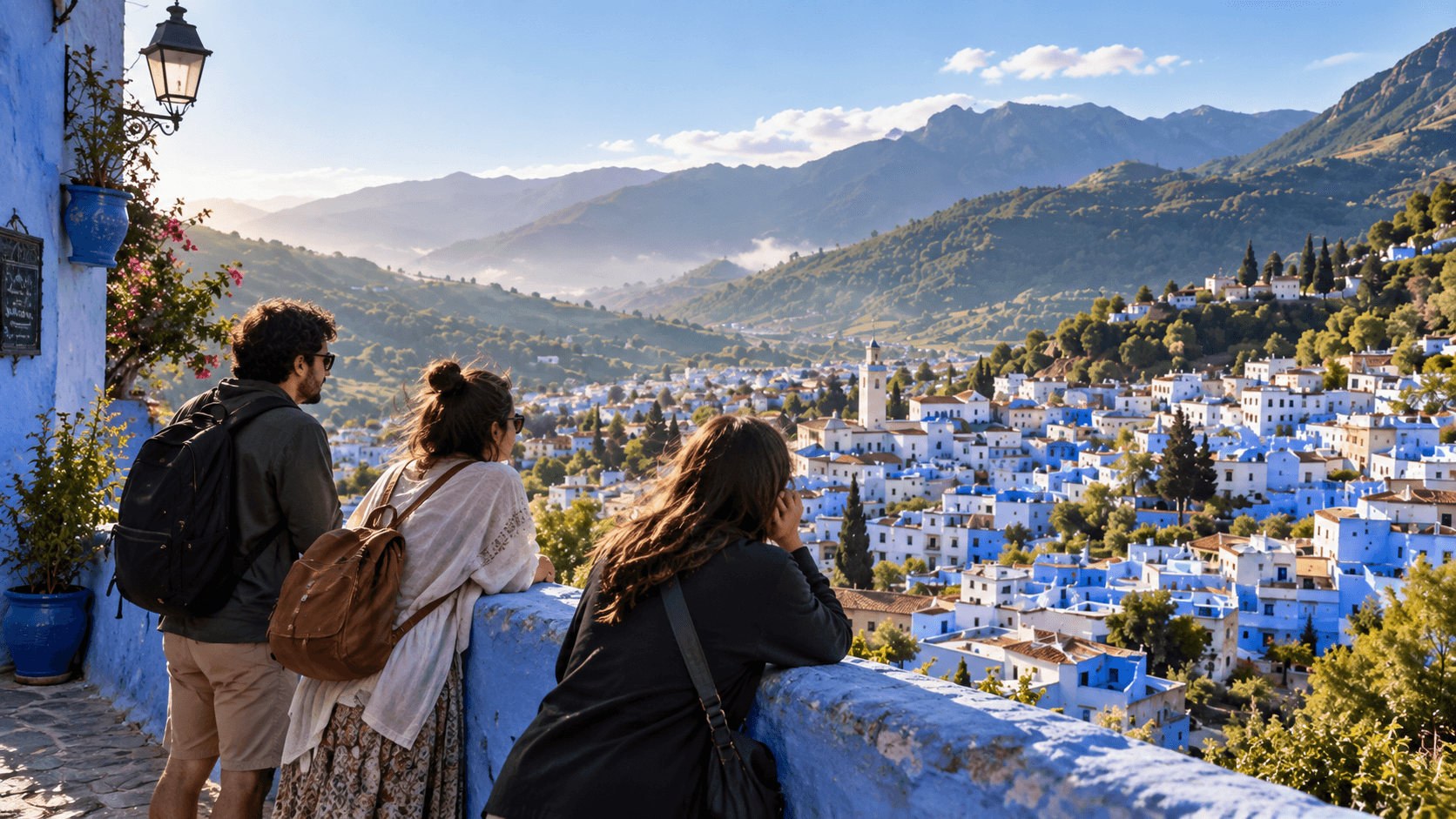
01Cross the Souss and the Anti-Atlas instead of the Tizi n’Tichka: Taroudant, the saffron fields at Taliouine and the rug looms of Taznakht.
 02
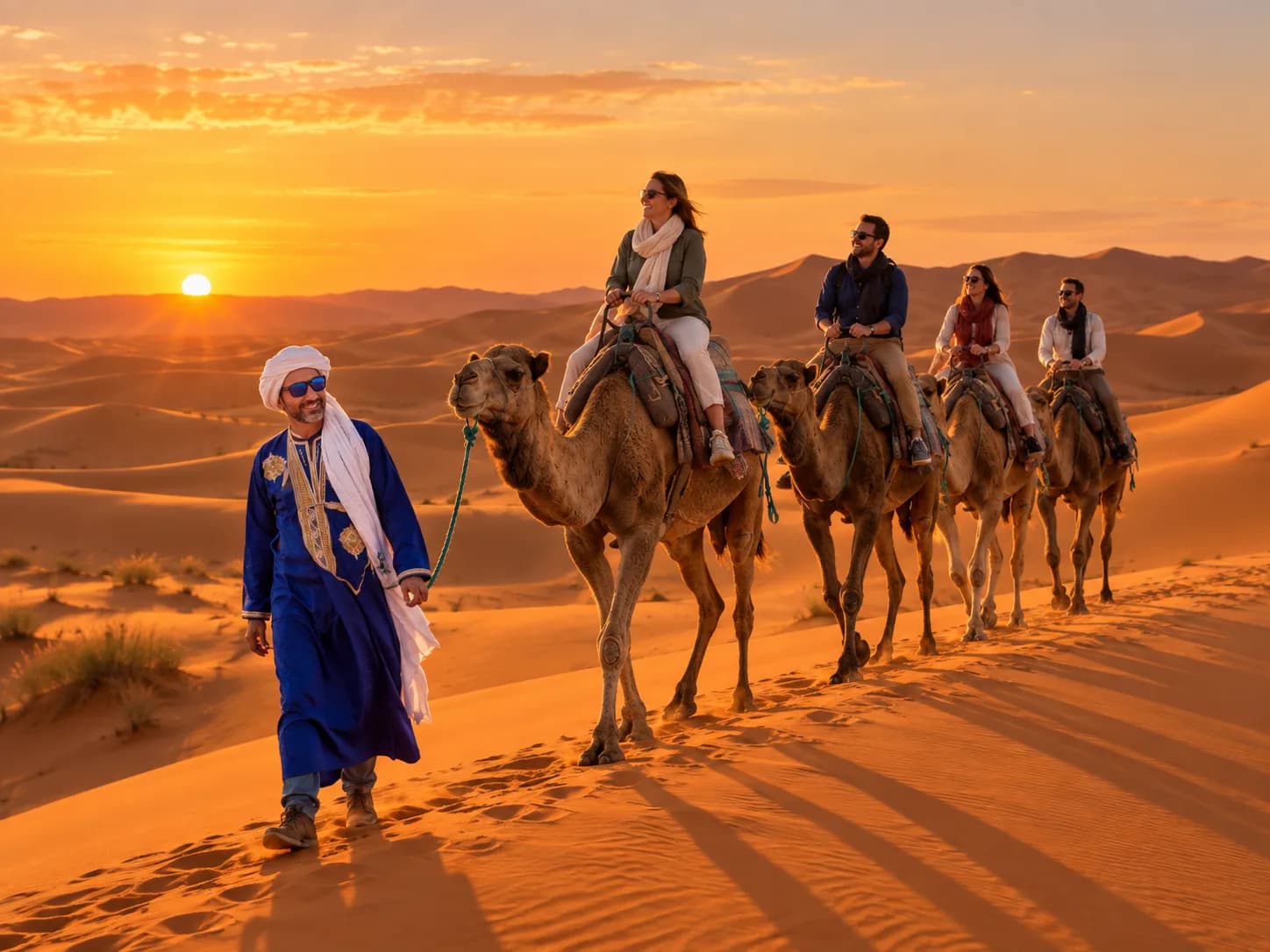
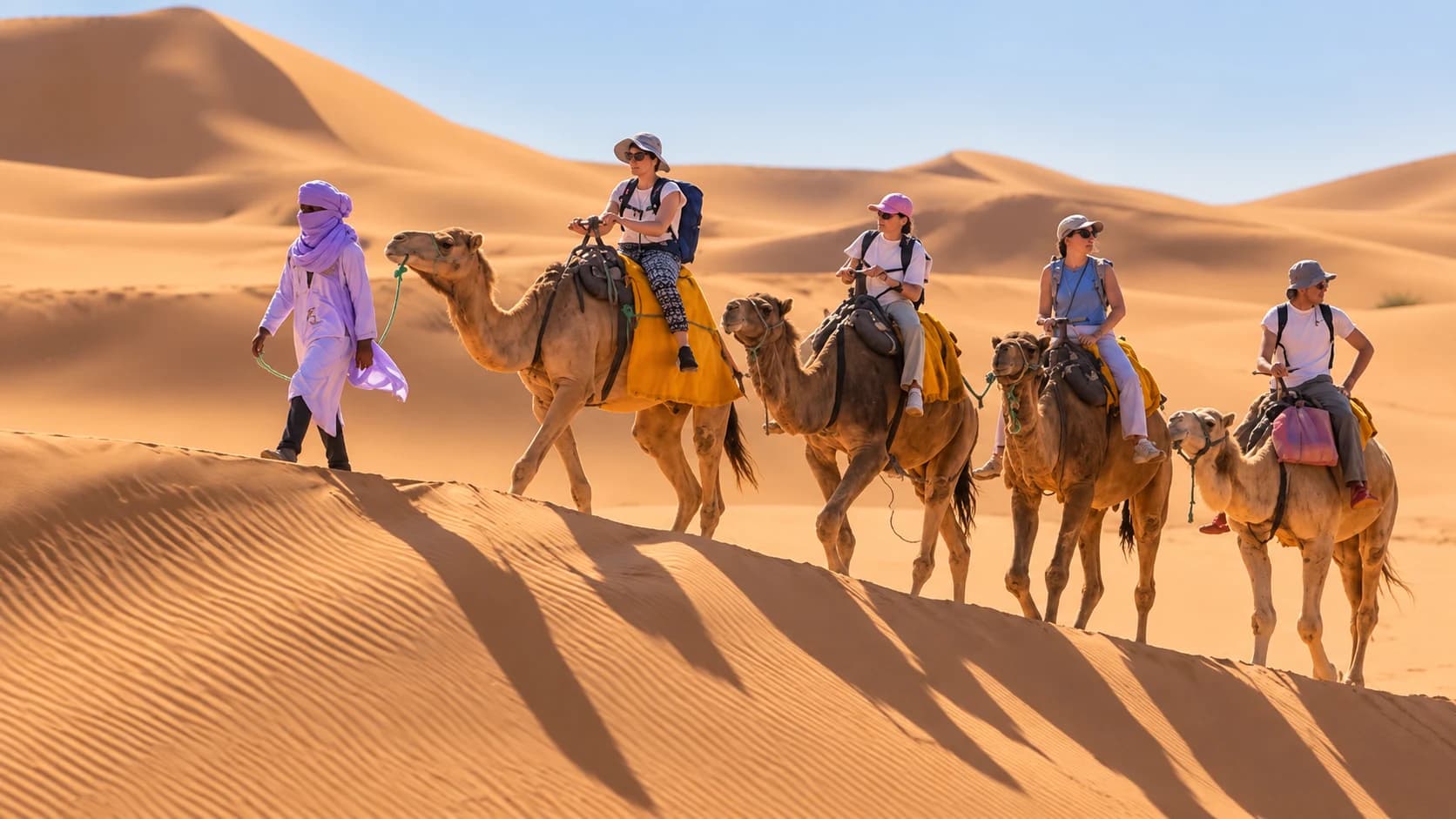
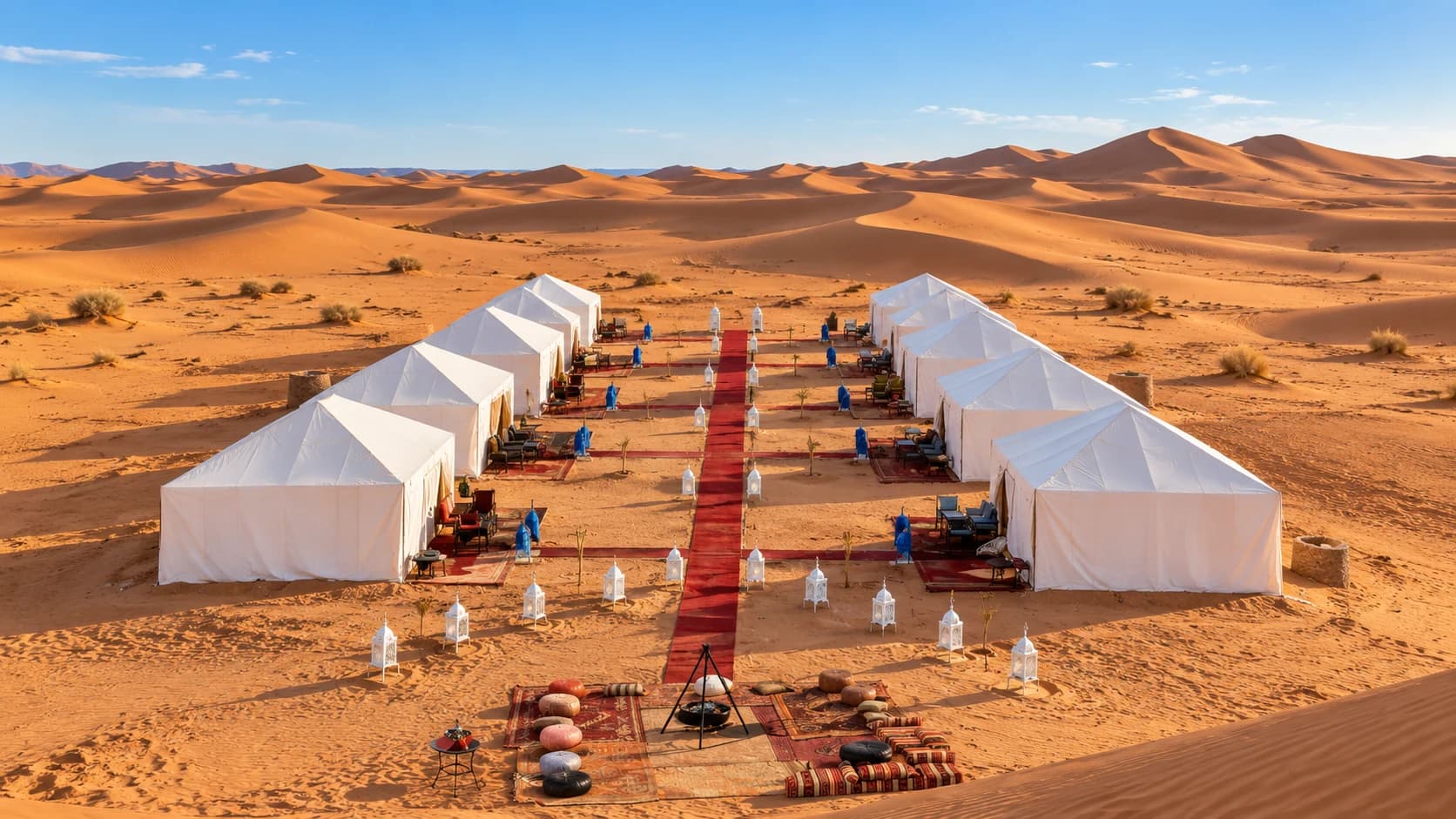
02End the day on a camel, an hour into the dunes, as Erg Chigaga turns from ochre to red.
 03
03Stay two nights at the same camp, sixty kilometres from the last village, without repacking in between.
 04
04Drink tea in a nomad family’s tent on day 2, then drive home across the dry bed of Lake Iriqui.
02 / Your itinerary
Your itinerary
3 days / 2 nightsAgadir → Agadir · Easy · a lot of driving and two off-road sections
We collect you from your hotel at half past eight. The Souss plain first, orange groves and argan trees, then Taroudant and its five kilometres of earth ramparts — we stop, walk twenty minutes through the Berber souk, and move on. The road then climbs to Taliouine, the saffron capital: harvest is late October, the rest of the year they are ordinary fields and we will not pretend otherwise. Lunch in Taznakht, where women weave the red Ouaouzguit rugs; it is unhurried, so take the time to step into a workshop. Past Foum Zguid the tarmac stops dead: sixty kilometres of piste, a plateau of stones, no signal, then the first dunes around five. Camels take over for the last hour into camp. Dinner under canvas, and a sky with no European equivalent.
This is the day that justifies the rest, and the reason we do not run this route in two days. Up before the sun on the big dune behind the camp — twenty minutes, and you can go back to bed afterwards. The morning by 4×4 out to the wells and to the tents of the nomad families who still live here part of the year: tea, bread baked under the sand, and a conversation that goes through your driver. Lunch in the shade, then the hot hours are spent lying down and nowhere else. Late afternoon, three hours on a camel into the erg, out to a ridge with forty kilometres of dunes in view and nothing else. Sandboarding on the north face if you fancy it. A second night in the same place: not repacking your bag in the desert changes a great deal.
A last sunrise over the dunes, breakfast at camp, and away around half past eight on a different piste from the one you came in on. You cross the bed of Lake Iriqui, dry since the seventies: ninety kilometres of pale track driven on sight between acacias, with gazelles early in the morning if you are lucky. The tarmac returns at Foum Zguid, lunch on the road, then Taznakht, Taliouine and the long descent into the Souss. Nine to ten hours in the car including stops — that is the price, and we do not hide it. Drop-off at your Agadir hotel around seven in the evening. If doing the whole road again sounds like too much, the four-day version adds a night in Taroudant on the way back and changes the last day entirely.
03 / Where you’ll stay
Two nights in one place, in the middle of the desert
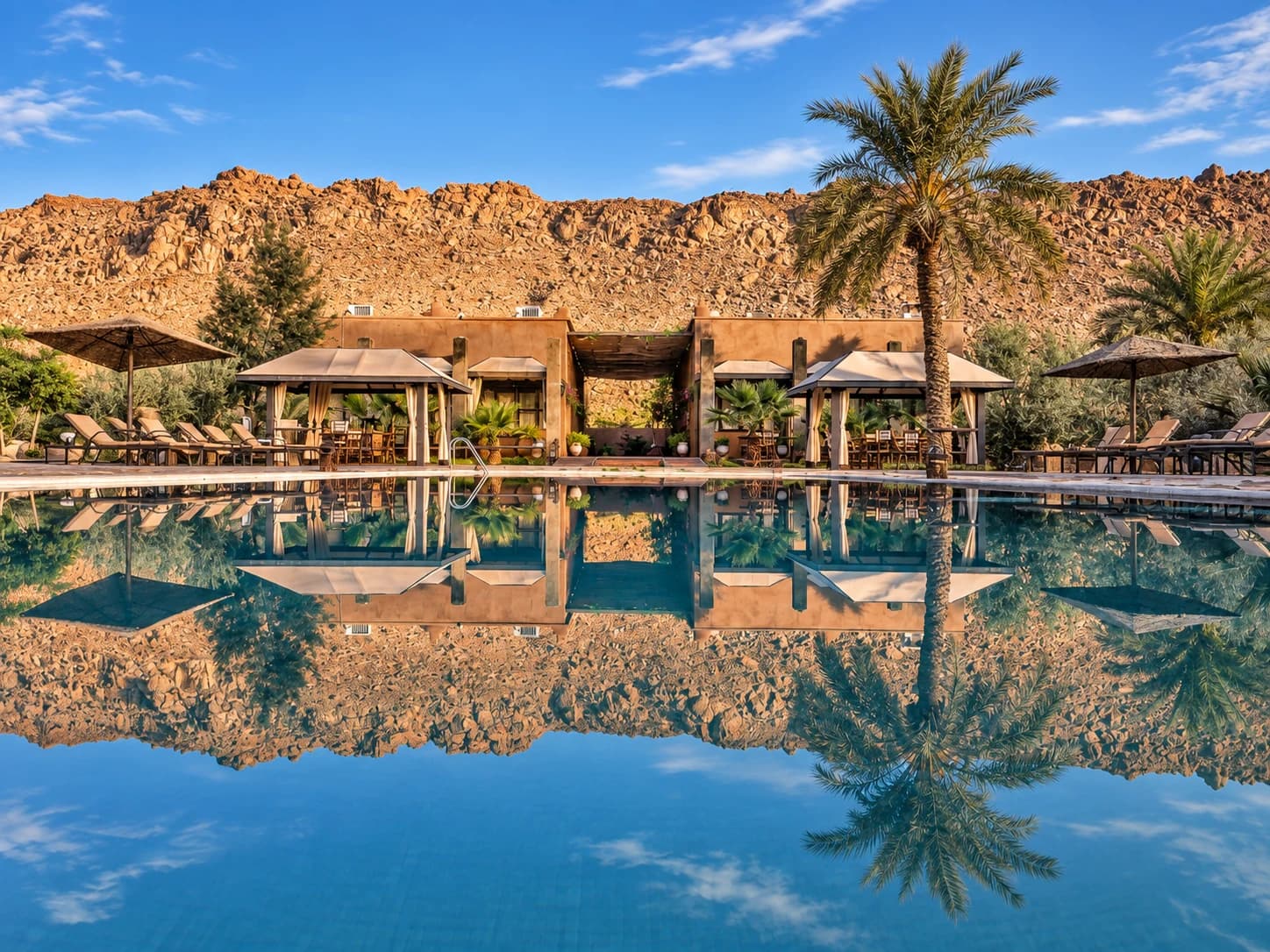
Camp Chigaga sits sixty kilometres from the last village, out of sight of the road, and you stay both nights. A private wool tent, a real bed, sheets, washrooms and hot water; about ten tents, not fifty, with no noisy generator and no sound system. Dinner is outside when the evening is mild, under the communal tent when the wind gets up, and the fire runs late. Nothing else is scheduled, and that is deliberate.
04 / The route, at a glance
The route, at a glance
Stops are indicative and can be adapted to your pace.
Agadir → Agadir
05 / Before you go
Before you go
- Ten hours of driving on day 1 and nine on day 3: that is the honest price of a there-and-back from Agadir, and we would rather say it here than in the car. The middle day never leaves the desert.
- A hundred and fifty kilometres of piste in total, including the Iriqui crossing on the way home. No danger and no walking, but corrugated track and dust: if one of you gets motion sickness, take something before you set off.
- The camp is comfortable rather than hotel-like: a private tent, a real bed, sheets, hot water, and no sound system. From December to February nights in the erg drop close to freezing, so bring a warm layer for the fire.
- October to April is the right window. From June to August Erg Chigaga regularly passes 45 °C and we genuinely advise against this route, even though Agadir stays mild at the same time.
- Morocco tips. Your driver and the camp team expect it; we tell you what is usual before you leave so it never feels awkward.
What’s not included
- Flights and airport transfers
- The day 1 lunch in Taznakht, and drinks
- Travel insurance (strongly recommended)
- Tips and personal expenses
- Quad biking and other optional dune activities
- Extra nights in Agadir before or after the tour
To prepare for this journey
Erg Chebbi or Erg Chigaga: which desert should you choose?What should you pack for the Moroccan desert?Can you visit the desert from Agadir in three days?Your questions
Can you really reach the desert from Agadir in 3 days?
Yes, and Erg Chigaga is in fact the most logical big erg from Agadir: 560 km against more than 700 to Merzouga. Three days give you two full nights in the dunes, two sunrises and one whole day that never leaves the desert. The price is days 1 and 3, both long. If that sounds like too much, the four-day version breaks the return with a night in Taroudant.
Erg Chigaga or Merzouga from Agadir?
Chigaga, without hesitation, if you are starting from Agadir. Merzouga is more than 700 km away and is reachable by ordinary car right up to the dunes, which is why there are over a hundred camps there. Erg Chigaga has to be earned: sixty kilometres of piste, and a handful of camps spread over forty kilometres of dunes. Merzouga has the taller dunes; Chigaga has the wider and far emptier ones.
How much does a 3-day desert tour from Agadir cost?
Expect €150–250 per person for a shared minibus departure, and €600–900 for a private tour with a camp we have chosen. Ours starts at €690 per person based on two travellers, and the price drops sharply from four upwards: at five or six it falls below €500. The gap comes down to the private 4×4, two nights at the same camp, and the fact that nobody else gets in the car.
Are the off-road sections hard going?
They shake you about. Sixty kilometres on the way in, ninety on the way back across Lake Iriqui: no danger, no walking, but corrugated track and a lot of dust. If one of you gets motion sickness, take something before you set off and tell the driver: he will slow down and stop more often. We advise against this route with a child under six or with a serious back problem.
When is the best time to go?
October to April. October–November and March–April are the best months: 22–28 °C in the erg by day, cool at night. In late October you pass through Taliouine during the saffron harvest, which is worth the trip on its own. In December and January the days stay fine but nights approach freezing. From June to August Erg Chigaga regularly passes 45 °C and we genuinely advise against this route.
What should I pack?
A small bag for the two nights — your suitcase stays in the 4×4. Closed shoes, a hat, sunscreen and sunglasses. A fleece or warm jacket even in April: the gap between midday and midnight often passes twenty degrees. A head torch is useful at camp, and you will be glad of a scarf on the day the wind gets up on the piste.
What do we eat at the camp?
You choose: couscous, a tagine, or a barbecue. It comes with Moroccan salad and mint tea. The camp kitchen is small and cooks to order, so tell us at booking if anyone is vegetarian or avoids something — it takes one sentence to sort out.
Is it the same driver for the whole trip?
Yes. The person who meets you on the first day stays with you until the final drop-off — the same driver-guide, the same vehicle. It sounds like a detail until the third day, when you no longer have to explain that you would rather stop for a coffee than for a photograph.
What does this trip support locally?
We give ten per cent of what we earn to small cooperatives in the regions we drive through, to help them grow their own business. It is not a line added to your invoice — it comes out of our side of it.
Your journey starts here
Let’s plan your journey.
Your dates, your wishes, your pace. Tell us what matters to you and our local team will reply with a personal proposal.
Or write to uscontact@kasbahroutes.com