The short answer
With six days, choose one clear axis or two nearby regions. Eight days allow a genuine circuit if you limit backtracking. Ten days can add pauses or a third atmosphere without turning every day into a transfer. The right pace depends more on consecutive nights than on the total distance advertised.
What each duration allows without unnecessary rushing.
| Duration | Recommended shape | What to avoid |
|---|---|---|
| 6 days | A linear itinerary or two well-connected regions | The north, desert and coast in one journey |
| 8 days | A complete circuit with one or two calmer nights | Changing hotel almost every evening |
| 10 days | Three atmospheres or a slower circuit | Adding stops without removing detours |
Begin with a line on the map, not a list.
Then add the fixed constraints: arrival city, departure city, flight times and any nights already booked. A route that looks logical can become unbalanced when it must return to the same airport before midday. Keep the first night simple after a late flight and place the final night close to departure. The protected time is not wasted; it reduces the chance that a road delay forces you to cancel the visit that mattered most.
Use nights rather than calendar labels when comparing proposals. A six-day trip with five hotel nights is not equivalent to six complete sightseeing days, and the arrival and departure days may contribute very little. Mark each night on the route and count how many mornings begin with luggage packed. This quickly shows whether a tour offers a stable base or asks you to reset every day. It also makes apparently small additions—one desert night or one northern city—easier to judge honestly.
Morocco brings together the Atlantic coast, medinas, Rif, Atlas, southern valleys and Sahara. That variety makes it tempting to add a destination to every day. The terrain strongly shapes travel, however: the High Atlas separates the Atlantic plains from Saharan regions, while the Rif and imperial cities form a different northern axis.
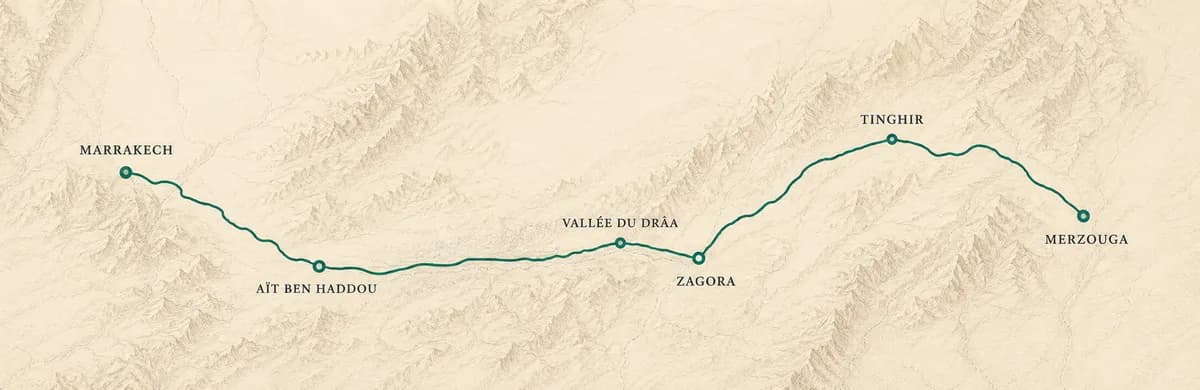
Draw the general direction first. A journey from Casablanca to Marrakech through Chefchaouen, Fez and Merzouga avoids returning to the starting point. A circuit from Marrakech through the kasbahs and desert can form a coherent loop. Every added return journey consumes time that a simple list of places fails to show.
Six days require a deliberate choice.
Six days can produce a rich journey when the route remains clear. You can travel from Casablanca to Marrakech through the north and Sahara, but the format will be mobile with several stages. Another option is Marrakech, the Atlas and Essaouira, or Marrakech and the south, with fewer kilometres and more time in each place.
This format suits travellers who accept regular departures and enjoy watching the landscape change from the road. It is less suited to slow mornings, several free half-days or three nights in one place. If one destination is essential, build around it and remove anything that requires crossing the country in the opposite direction.
Eight days make a true circuit possible.
With eight days, several landscapes can be connected while preserving at least one two-night stop. A route through the imperial cities towards Chefchaouen has time to discover Fez; a kasbah circuit can include valleys, gorges and dunes without treating the desert night as an isolated return trip. Two extra days do not double the possibilities, but they greatly improve breathing room.
Use that margin to slow down rather than automatically adding two cities. A second night creates time for a complete guided visit, a walk or a morning without luggage. It also protects the route when weather or roads affect an arrival. An eight-day circuit is still active; it becomes enjoyable when every long day is followed by a gentler one.
Ten days allow greater depth.
Ten days can hold a third atmosphere, perhaps medinas, the High Atlas and Atlantic, or a north-to-south route with a slower desert stop. The best use of those days is not always another destination. An extra night in Fez, a valley or Essaouira reveals a city waking up, creates room for a walk and leaves some time unplanned.
Keep a geographic logic. Chefchaouen, Essaouira and Merzouga are all reasonable ambitions, but combining them creates long diagonals. If all three matter, consider arriving and departing from different cities and accept several road days. Otherwise keep one for a future journey.
Count hotel changes and early starts, not only driving hours.
Fatigue comes from the whole pattern: packing again, leaving accommodation, settling elsewhere, changing climate and absorbing new places. Three separate four-hour stages do not feel like one long day followed by two stable nights. Look at how many mornings begin with departure and how many evenings end in a late arrival.
For a family journey, honeymoon or first trip after a long flight, reduce the geographic ambition by one level. Travellers used to road trips may love a busier linear itinerary. Say clearly whether the road is part of the pleasure or a cost to minimise; that answer is more useful than a universal ideal duration.
Remove a stop when the journey loses its centre.
A strong itinerary can be described in one phrase: north to south, medinas to desert, or Marrakech to the ocean through the Atlas. If the programme requires several unrelated sentences, it is probably overloaded. Remove the stop that creates backtracking or offers only a photograph between two drives.
Before confirming, request daily driving estimates, likely departure times and the number of nights in each accommodation. Check arrival and departure airports too. These details make the pace visible and show where an extra day has the greatest value: rarely in a detour, usually in a place already chosen.