The short answer
Yes, you can visit Merzouga from Marrakech in three days if you are comfortable with a busy pace and a long return journey. To break up the drive and allow more time at each stop, ask for a four-day version with an overnight stop on the way back.
One extra day. What changes?
| Your trip | 3 days | 4 days, tailored |
|---|---|---|
| Pace | Busy, with a long final day | More flexible if the return is split over two days |
| Nights | Two nights, including one at the Merzouga camp | Three nights; the extra stop is planned together |
| Time in the dunes | A late-afternoon arrival and the following morning | It varies: an overnight stop en route does not mean a second night in the dunes |
| Best suited to | Travellers comfortable with long driving days | Those who want to break up the journey and allow more breathing room |
The real consideration is the drive.
Look at each day separately rather than at the total mileage. The outward journey crosses the High Atlas and changes landscape repeatedly, so it may feel rewarding despite the hours in the vehicle. The return from Merzouga is different: a substantial distance follows an early desert morning. Ask for the expected departure time, the number of genuine visits and where meals are planned. This reveals whether the programme preserves time to experience the route or uses most stops primarily to make the drive manageable.
What happens after the circuit matters too. If you have another night in Marrakech, a later-than-planned arrival remains manageable. If a flight, train or separate excursion is booked that evening, any delay becomes stressful. Keep a buffer night after the return whenever possible. It does not reduce the distance, but it prevents the last day becoming a race against a fixed reservation and gives the driver room to adapt breaks to traffic, weather and the group’s condition.
Merzouga sits beside Erg Chebbi in eastern Morocco. From Marrakech, the journey crosses the High Atlas before continuing through the landscapes of the south. The road is a substantial part of the trip, not a short transfer to camp.
Our three-day itinerary allows roughly nine hours for the return day. Treat that as a planning estimate, not a guaranteed arrival time: stops, traffic, weather and road conditions can extend the journey. Avoid booking a flight for the evening you return to Marrakech.
What you experience in three days.
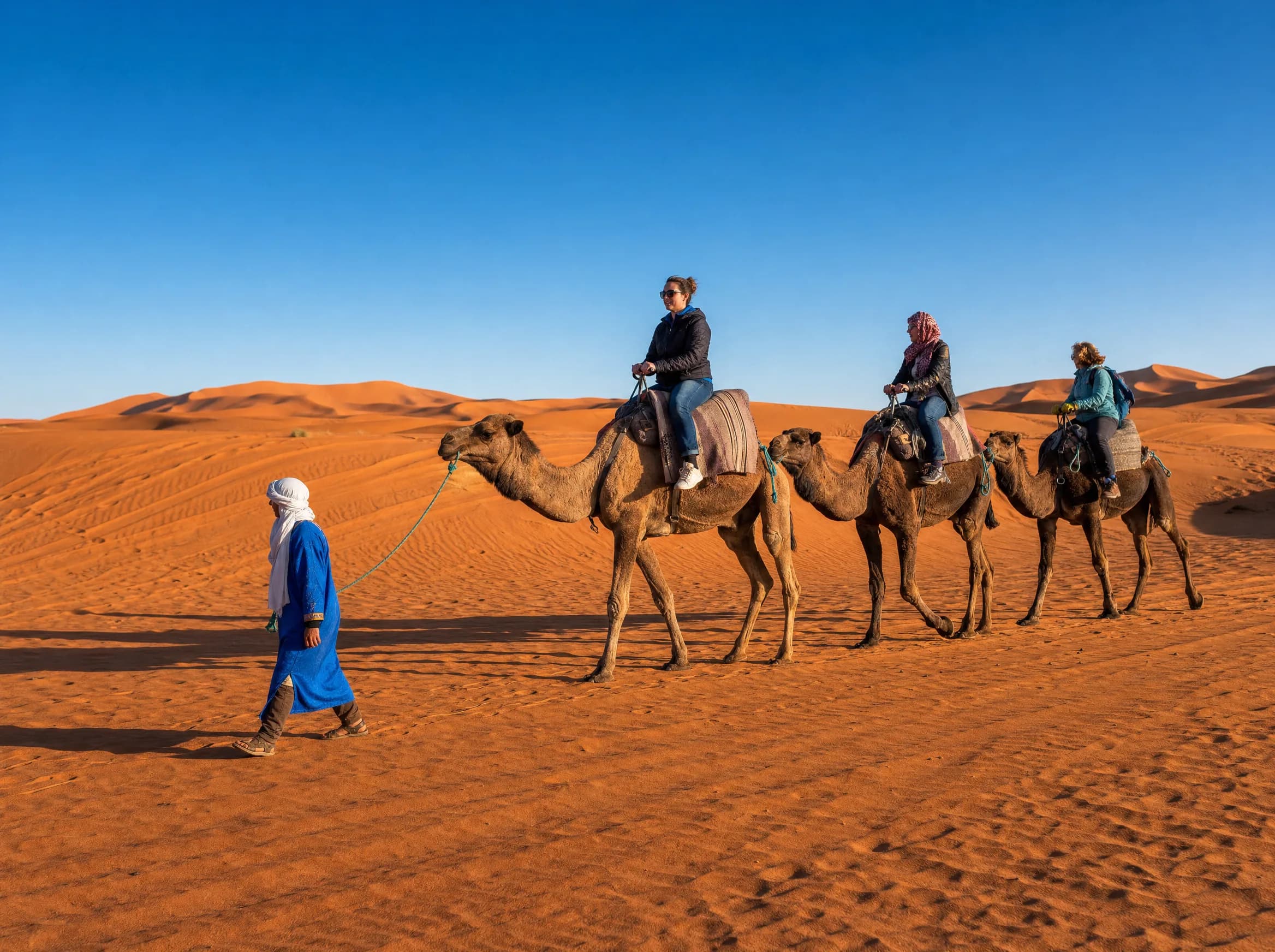
Treat the desert night as one part of a southern route, not as a self-contained resort stay. Arrival time affects the camel outing or 4×4 transfer, sunset cannot be delayed, and winter daylight is limited. If photography, a long dune walk or a quiet afternoon at camp is important, say so before the route is fixed. Those wishes may justify a fourth day or a second desert night more clearly than a general request to make the trip less rushed.
Day one takes you from Marrakech across the Tizi n’Tichka pass to Aït Ben Haddou. An overnight stay here leaves time to explore the ksar before continuing towards the desert.
Day two continues to Merzouga, with the stops listed in the itinerary, including the Todgha gorges. Late afternoon and the night at camp are the focus of the dune experience. Activity timings depend on your arrival and local conditions.
Day three begins in the desert before the drive back to Marrakech. This format gives you a taste of the dunes and southern Morocco, with little room for a full day without driving. The detailed tour programme remains the reference for what is included.
What a fourth day can change.
One option is to add an overnight stop between Merzouga and Marrakech, splitting the return drive. The exact stop depends on your interests, accommodation availability and chosen route. This creates more room for breaks and visits.
You might instead want more time near the dunes. Mention this early: an extra desert night and a stop on the return journey solve different needs. A fourth day does not automatically provide both without changing the rest of the itinerary.
The four-day version is tailored on request. Its price and inclusions are set out in a separate proposal; the advertised three-day price does not automatically apply.
Choose according to how you feel about driving.
Three days can work if your dates are tight, you enjoy watching the landscape change and you do not mind long stretches in the car. It is less suited to travellers who want slow mornings or plenty of free time at every stop.
If you are travelling with children, find winding roads tiring or need frequent breaks, discuss the pace before booking. Four days offer flexibility but do not remove the distance or mountain roads.
Before confirming, ask for each day’s expected driving time, the overnight stops, how you reach camp and the estimated return time. These details help you compare proposals beyond the number of days alone.
What to confirm before departure.
Ask whether the listed stops are genuine visits and how much time they allow. Confirm how the camp is reached, the approximate timing of the camel or 4×4 transfer, the tent type and included meals. If sunrise matters to you, mention it: timing changes with the season and can be particularly early in summer.
Preserve some margin in Marrakech after the return. A final night in the city protects your flight and allows the journey to finish without watching the clock throughout the drive. For many travellers, that buffer creates more comfort than a poorly placed fourth day because it separates the southern adventure from the international departure.