The short answer
Allow for roughly five to eight kilometres of walking during a full sightseeing day, while remembering that distance is only part of the effort. Uneven lanes, steps, slopes, crowds and long periods standing make a medina more tiring than an equally long walk on level ground.
Not every medina day demands the same effort.
| Type of day | Likely rhythm | What to arrange |
|---|---|---|
| Full guided visit | Several hours on foot with frequent stops | Stable shoes, water and a seated break |
| Independent visit | Variable distance and frequent detours | Offline map and your riad address in writing |
| Limited mobility | A short route planned in detail | Check vehicle access, steps and toilets |
| With children | Shorter sections and regular pauses | One main objective rather than a complete list |
Distance tells only part of the story.
A phone may record few kilometres while missing much of the fatigue. In a medina you stop, step aside for a handcart, climb to a terrace, stand through a workshop visit and occasionally retrace your route. Surfaces change without warning. Ask for an estimate in hours, the number of seated visits and whether a vehicle can be reached halfway through. That description is more useful for comparing two days than a kilometre target on its own.
Time of day matters as well. A morning visit can offer quieter lanes and leave the afternoon for a garden, café or riad. Two long guided visits in succession may be more tiring than a varied day even when the distance is identical. If you arrive after a transfer, do not immediately schedule the densest circuit. A short first loop helps you understand the slopes, crowds and your own comfort level before committing to a longer walk on the following day.
Build recovery into the route rather than waiting until someone is exhausted. Agree on a café, museum courtyard or riad where the group can sit, use a bathroom and decide whether to continue. Travellers with different energy levels can sometimes separate for one visit and meet again at an easy landmark. A private guide should explain these options early, before the narrow streets or noise make a simple decision feel difficult.
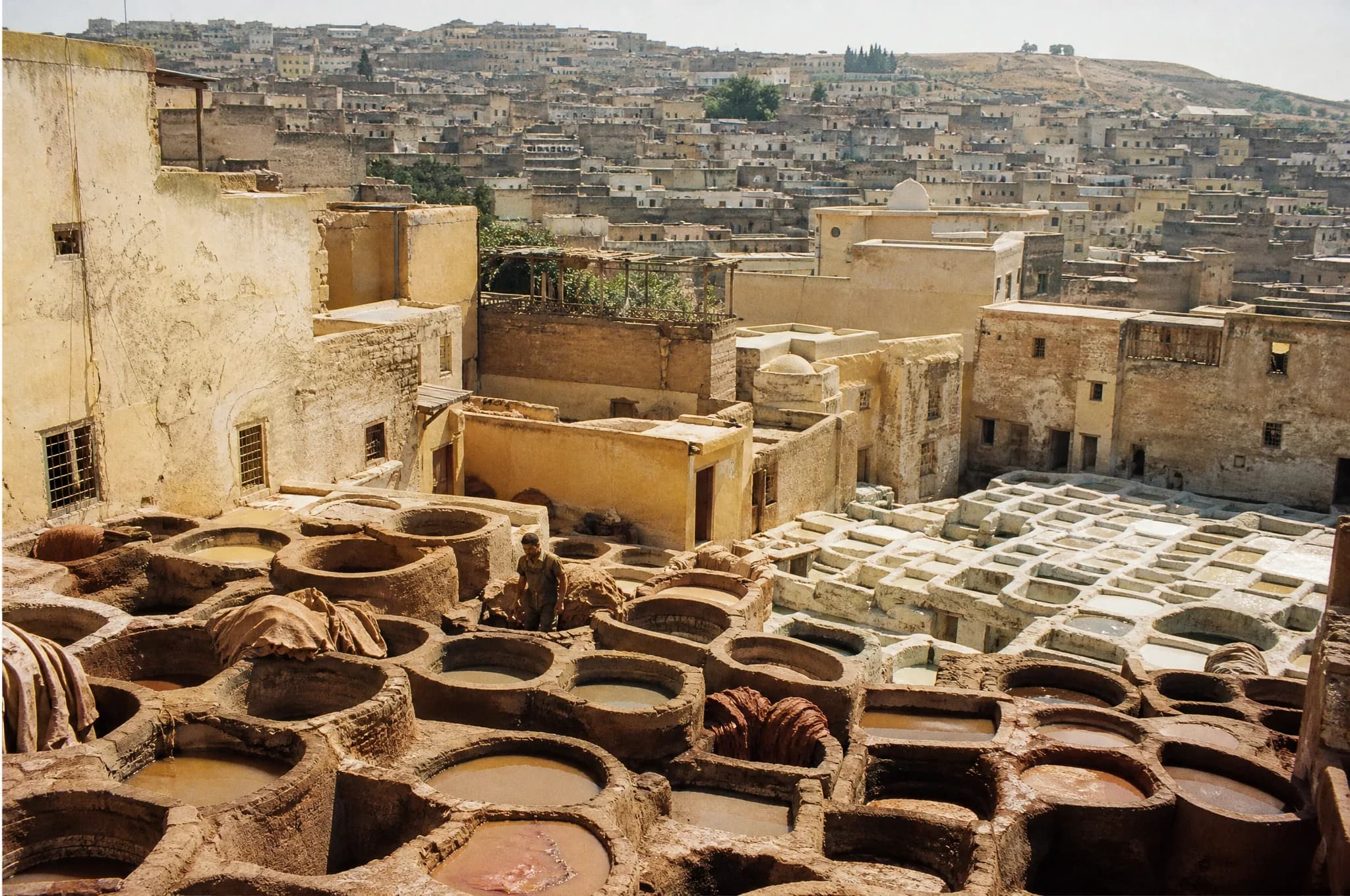
You rarely walk in a straight line inside a medina. A gate, workshop or market may require a detour, while a lane that looks close on a map can end in steps. In Fez, the historic urban fabric is particularly extensive and dense. In Marrakech, major sights sit within a lively area where stops and changes of direction are constant.
Five kilometres walked slowly, with indoor visits and long periods standing, can feel harder than eight kilometres on an even promenade. Ask how long you will be on your feet, how many interiors are included and whether the route has slopes rather than focusing on a kilometre total. A well-paced day alternates discovery, explanation, rest and calmer transfers.
Choose stability before elegance.
Surfaces change frequently: polished paving, uneven stone, thresholds, small steps and occasionally damp passages. A closed shoe that you have already worn, with a gripping sole and enough room for your toes, is more useful than a new or very rigid pair. Heels and completely smooth soles quickly turn an enjoyable walk into an exercise in concentration.
Carry as little as possible during the visit. A small bag, water bottle and light layer are usually enough. Compact luggage makes narrow passages easier and keeps your hands free. If you use a walking stick, mention it to your guide because some routes provide more reliable footing than others.
A guide mainly reduces mental fatigue.
A guide cannot remove the stones or steps, but can prevent unnecessary detours and organise the day around your priorities. In the medina of Fez, whose scale and intricate urban fabric are highlighted by UNESCO, this orientation genuinely changes the experience. You can pay attention to places, craftspeople and explanations rather than repeatedly checking your position.
Explain at the beginning what you want to see and what you would rather avoid. A visit does not have to cover every monument to be worthwhile. A workshop, madrasa, lunch and a few carefully chosen lanes may offer more understanding than a long list rushed through. A guide can also place the steeper sections before late-day fatigue sets in.
Accessibility needs to be checked street by street.
Medinas are living historic cities, not spaces built to one modern accessibility standard. Some entrances are close to vehicle access; others require several minutes through narrow lanes. Riads may have thresholds, steep stairs and no ground-floor room. A broad description such as “accessible” is therefore not enough.
Before booking, ask for the exact distance between the drop-off point and accommodation, the number of steps to the room, whether a ramp exists and whether a shorter visit can be arranged. Wheelchair and walking-frame users need concrete, current answers. If mobility changes from day to day, plan an option that can be shortened without losing the visit’s main purpose.
Keep one strong ambition for each half-day.
Morning is often best for visits that demand attention. After two or three hours, a proper seated break is more useful than a coffee taken standing. Choose a second nearby area afterwards rather than crossing the whole city. This reduces unnecessary transfers and leaves room for what gives a medina its character: an open doorway, a conversation or an unplanned workshop.
With children or older travellers, let the group’s pace lead. Returning to the riad at midday, taking a long lunch or using a vehicle between neighbourhoods is not wasted time. The right programme is the one that leaves you able to notice your surroundings in late afternoon, not the one that checks off the most addresses.